A SOC report is an independent audit report that evaluates the security controls a service organization uses to protect the systems, applications, and data it manages on behalf of its customers. The audit is performed by a licensed CPA firm, not by the company being reviewed, which is what gives the findings independent weight. A SOC report can examine identity and access controls, monitoring practices, change management, incident response, and data handling, then document whether those controls are properly designed and, in most cases, whether they actually operated as intended over a period of time.
For IT leaders and compliance teams, a SOC report solves a practical problem: verifying a vendor’s security claims without direct access to that vendor’s systems. Instead of relying on a vendor’s own description of its controls, a SOC report shows what an independent auditor tested and found. This makes it a central document in vendor risk management, security due diligence, and ongoing SOC risk management programs across cloud and SaaS environments.

What Does a SOC Report Mean?
If you are asking what a SOC report means in practical terms, the short answer is that it’s documented proof, not a self-reported claim. SOC stands for System and Organization Controls. The report is the output of a formal audit process where a CPA firm reviews an organization’s controls against a defined set of criteria and states an opinion on what it found.
A vendor may say it encrypts data, restricts access, and monitors its systems around the clock. A SOC report is where that statement gets tested. The auditor reviews policies, examines technical configurations, and collects evidence, access logs, change records, monitoring alerts to confirm whether those controls exist and function as described.
This distinction between design and operation matters. A control can be well designed on paper and still fail in practice if nobody enforces it consistently. A SOC report is built to catch that gap, which is why IT leaders treat it as a stronger signal than a vendor security questionnaire alone.
How Does a SOC Report Work?
A SOC report is built around a structured audit process, not a single inspection. When an organization undergoes a SOC audit, the auditor first defines the scope: which systems, services, and control objectives will be evaluated. Scope matters because a SOC report only speaks to what was actually reviewed; a vendor with multiple products may have only one platform covered by a given report.
From there, the auditor reviews documented policies and procedures, then moves into evidence testing. This can include reviewing access logs, configuration exports, ticketing records, and interviews with control owners to confirm controls operated as intended. For a report covering a period of time, this evidence has to span the entire review period, not just a single day.
The process does not end at testing. The auditor forms a formal opinion, documents any exceptions or control failures identified, and issues the final report. This is how a SOC report audit moves security evaluation away from vendor self-assurance and toward independently verified evidence.
SOC Report vs. Traditional Security Assessments
Security teams often confuse a SOC report with other assessments that answer different questions. A SOC report evaluates a broad set of controls and processes over time; other assessments focus on specific technical weaknesses at a single point in time.
Assessment | What It Evaluates | Best Used For |
SOC Report | Whether internal controls are designed and operating effectively, based on independent audit testing over a period | Vendor due diligence, ongoing SOC risk management, demonstrating control maturity to customers |
ISO 27001 Certification | Whether an information security management system meets an international certification standard | Showing a structured, certified security program at the organizational level |
| Penetration Testing | Whether specific systems can be actively exploited by simulating a real attack | Finding exploitable technical vulnerabilities in a defined environment at a point in time |
| Vulnerability Assessment | Known technical weaknesses such as outdated software, missing patches, or misconfigurations | Ongoing technical hygiene and prioritizing remediation |
A SOC report and a penetration test are not interchangeable. One evaluates whether a broad set of controls and processes function correctly over time; the other tries to break into a system directly, right now. Mature security programs typically use several of these assessments together rather than treating any single one as sufficient on its own.
What Are the Core Components of a SOC Report?
A SOC report is more than a summary of an audit. It is a detailed document that explains what was reviewed, how security controls were tested, and what the auditor found during the assessment. Each section of the report provides a different view of an organization’s security practices. Understanding these components helps businesses evaluate the scope of the audit, the effectiveness of controls, and any areas that may require attention.
System Description
A written description, prepared by the organization’s management, explaining the systems, infrastructure, and services included in the audit’s scope. This sets the boundaries for everything the auditor tests.
Management Assertion
A formal statement from company leadership asserting that the organization’s controls are designed and, for a Type II report, operated to meet the relevant criteria. This is the company’s own claim before the auditor’s findings are added.
Control Objectives and Criteria
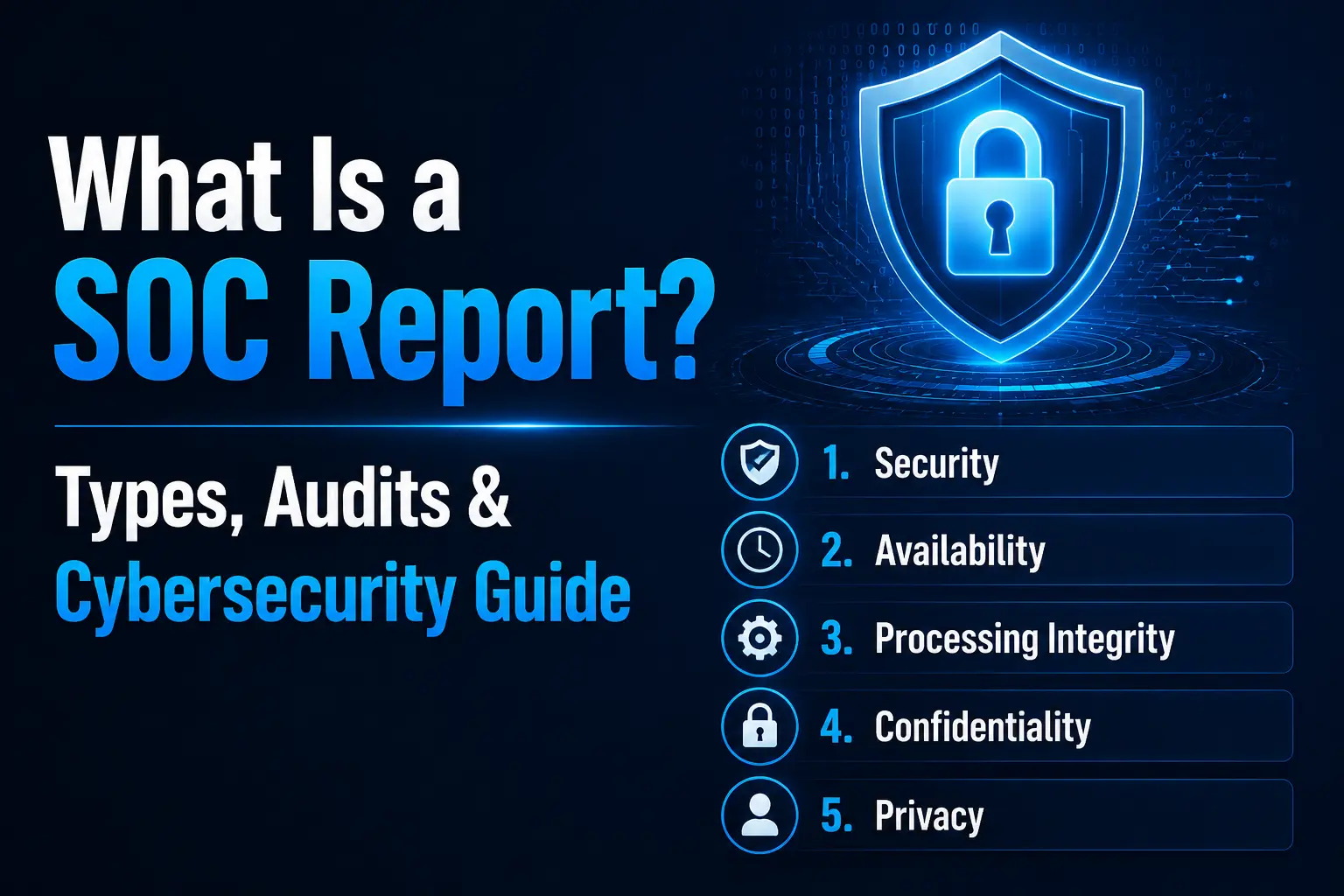
The specific goals each control is meant to achieve, often mapped to the AICPA’s Trust Services Criteria: security, availability, processing integrity, confidentiality, and privacy.
Testing Procedures
A description of exactly how the auditor tested each control, what evidence was reviewed, what sampling method was used, and over what time period.
Results and Exceptions
The outcome of that testing, including any exceptions, control failures, or deviations the auditor identified along the way.
Auditor’s Opinion
The auditor’s formal conclusion on whether the controls met the stated criteria. This is the section most people skip to, but it only makes sense in the context of everything documented above it.
Why Is a SOC Report Important for Cybersecurity?
An SOC for a cybersecurity report matters because it replaces assumptions with tested evidence. Any vendor can claim strong security in a sales conversation. A SOC report is one of the few documents that backs that claim with independent verification rather than self-reporting. This is especially relevant in vendor relationships. When a business hands sensitive data to a cloud provider, SaaS platform, or payment processor, it also inherits that vendor’s security risk. A SOC report gives security teams a documented basis for evaluating that risk during onboarding and throughout the relationship, rather than discovering gaps only after an incident.
The independence of the audit is what gives it credibility. The auditor has no financial incentive to make a vendor’s controls look better than they are. That’s why a current, clean SOC report functions as a trust shortcut: it tells a customer that someone with no stake in the outcome has already verified the fundamentals, which shortens due diligence cycles and builds compliance confidence on both sides of a deal.
What Are the Different Types of SOC Reports?
There isn’t a single, universal SOC report. The different SOC report types are built for different audiences and different questions.
SOC 1 Report
It focuses on controls relevant to a service organization’s impact on its customers’ financial reporting. Common for payroll processors, claims administrators, and financial transaction platforms.
SOC 2 Report
It evaluates controls against the Trust Services Criteria for security, availability, processing integrity, confidentiality, and privacy. Security is required in every SOC 2 report; the rest are included based on relevance. This is the report most SaaS and cloud providers pursue, since it maps directly to what customers ask about.
SOC 3 Report
It covers the same Trust Services Criteria as SOC 2, but in a general-use format that omits sensitive technical detail. Because it’s safe to distribute publicly, companies often post their SOC 3 report as a trust signal on their website.
SOC for Cybersecurity
It separates the AICPA framework that looks at an organization’s cybersecurity risk management program at the entity level, rather than one specific system or service. It’s typically produced for boards and senior leadership rather than shared with individual customers.
SOC Type I vs. Type II
Every SOC 1 and SOC 2 report is also issued as either a Type I or Type II. A Type I report confirms controls are suitably designed as of a single point in time. A Type II report goes further, confirming those controls also operated effectively over a review period usually three to twelve months. Type II is generally treated as the stronger form of assurance.
How to Prepare for a SOC Report Audit?
Preparing for a SOC report audit requires more than collecting documents at the last moment. Organizations need to ensure that their security controls, policies, and processes are properly documented and working as expected. A good preparation process helps businesses identify gaps before the audit begins, organize the required evidence, and improve their overall security readiness.
Step 1: Define Scope and Report Type
Decide which systems, services, and SOC report type (1, 2, or 3, and Type I or II) match what your customers or contracts actually require.
Step 2: Inventory Existing Controls
Document current policies, technical safeguards, and processes across access management, monitoring, change management, and incident response.
Step 3: Perform a Readiness Assessment
Compare documented controls against the relevant criteria to identify gaps before the formal audit begins. This is where most organizations find the issues an external auditor would otherwise flag first.
Step 4: Collect Evidence in Advance
Gather access logs, configuration records, and audit trails ahead of time rather than scrambling for them once testing starts.
Step 5: Remediate Identified Gaps
Address weaknesses found during readiness review, tightening access controls, formalizing incident response steps, or improving monitoring coverage.
Step 6: Engage the Auditor
Select a CPA firm experienced with the relevant SOC report type and begin the formal audit with documentation and evidence already in place.
Step 7: Review Findings and Maintain Controls
Once the report is issued, review any exceptions noted and keep controls operating consistently, since most SOC 2 Type II reports are renewed annually.
How Does a SOC Report Work Across Multiple Vendors and Cloud Environments?
Many organizations don’t rely on just one vendor’s SOC report; they manage a portfolio of them across cloud providers, SaaS tools, and subcontracted services. This gets more complex when a vendor itself relies on subservice organizations, such as a SaaS company hosting its infrastructure on a cloud provider.
A SOC report handles this in one of two ways. The inclusive method tests the subservice organization’s controls directly as part of the primary report. The carve-out method excludes the subservice organization’s controls from testing and simply notes that customers should review that provider’s own SOC report separately. IT leaders reviewing a vendor’s SOC report should check which method was used, since a carve-out means part of the risk picture sits in a different document entirely.
SOC Reports for Small and Mid-Sized Businesses
Smaller SaaS companies and service providers can pursue a SOC report without building a large, dedicated compliance function. A practical starting point often includes:
- Starting with a SOC 2 Type I to demonstrate control design before committing to a full Type II
- Documenting core policies around access control, incident response, and data handling
- Using existing cloud provider security features rather than building custom controls from scratch
- Running an internal readiness assessment before engaging an auditor
- Scoping the first audit narrowly, then expanding coverage as the business grows
A phased approach lets smaller organizations build toward a SOC 2 Type II over time, rather than treating the first audit as the finished state.
Common SOC Report Mistakes That Businesses Do
Common problems that show up during SOC report audits and reviews include:
- Treating a SOC report as a one-time project instead of an ongoing control discipline
- Assuming a report covers every product or system a vendor offers, without checking scope
- Collecting evidence only right before the audit instead of throughout the year
- Leaving control ownership unclear, which slows down evidence collection
- Accepting a vendor’s SOC report without reading the exceptions section
- Confusing SOC 2 with a certification, when it’s actually an attestation report
- Ignoring the carve-out method and missing a subservice organization’s own risk
- Letting a SOC report go stale past its review period without renewal
Most of these issues aren’t about weak security itself, they’re about the absence of proof that good controls were followed consistently, which is exactly what a SOC audit is designed to catch.
How Do You Measure SOC Risk Management Progress?
SOC risk management works best when it’s tracked over time, not treated as a one-time checkbox during vendor onboarding.
Metric | What It Shows |
Vendor SOC coverage | How many critical vendors have a current SOC report on file |
Report currency | How many SOC reports are within their valid twelve-month window |
| Exceptions trend | Whether the number of noted exceptions is increasing or decreasing year over year |
| Time to remediate findings | How quickly identified control gaps get fixed after a report is issued |
| Carve-out visibility | Whether subservice organization risk is being tracked separately when carve-out methods are used |
| Review completion rate | How many vendor SOC reports were actually read and assessed, not just filed |
Tracking these metrics turns SOC risk management from a compliance formality into an ongoing part of vendor and security governance.
How CyberZeals Helps With SOC Report Readiness and Risk Management
CyberZeals works with organizations preparing for a SOC report audit and with businesses evaluating vendors’ SOC reports as part of their own risk process. Our services related to SOC reports include:
- Cybersecurity Services in the USA
- Operational Security in the USA
- Cloud & Data Center Security in the USA
- Application Security in USA
- Network and Infrastructure Security in the USA
- Penetration Testing in the USA
The goal is to turn a SOC report, whether you’re preparing one or reviewing someone else’s, into a genuine improvement in security posture and vendor risk management, not just a document filed away after a deal closes.
FAQs
Is a SOC Report the Same as an ISO 27001 Certification?
No. A SOC report is an audit report with detailed testing results and an auditor’s opinion. ISO 27001 results in a certification confirming a management system meets an international standard.
Does a SOC Report Replace Penetration Testing?
No. A SOC report evaluates broad controls and processes over time. A penetration test actively tries to exploit systems at a specific moment. Most mature programs use both.
Is a SOC Report Legally Required?
Not usually. Few laws mandate a SOC report directly, but many contracts, customer requirements, and industry expectations make one practically necessary for SaaS and cloud vendors.
Can One SOC Report Cover Multiple Cloud Providers?
Sometimes, through the inclusive method. More often, a vendor’s SOC report carves out its cloud provider’s controls and points to that provider’s own SOC report separately.
Is SOC for Cybersecurity the Same as SOC 2?
No. SOC 2 evaluates one specific system or service. A SOC for cybersecurity report assesses an organization’s entire cybersecurity risk management program at the entity level.
What Is the First Step in Preparing for a SOC Report Audit?
Start with scope: decide which systems, services, and report type actually match what your customers or contracts require, then inventory your existing controls against that scope.
Is a SOC 2 Type II Report Better Than a Type I?
For most vendor evaluations, yes. Type II tests whether controls operated effectively over several months, not just whether they were designed correctly in one day.
If you have any query, then call us on +1 888 533 0044 or contact us now and get in touch with us.