Real Technology Outcomes Delivered by CyberZEALS

CyberZEALS helps businesses improve IT performance, strengthen cybersecurity posture, ensure cloud reliability, achieve compliance readiness, and build operational resilience with measurable results.

Real Technology Outcomes Delivered by CyberZEALS

CyberZEALS helps businesses improve IT performance, strengthen cybersecurity posture, ensure cloud reliability, achieve compliance readiness, and build operational resilience with measurable results.

40%

Fewer Incidents

2X

Faster Recovery

24/7

Security Visibility

99.9%

Cloud Uptime

Incident Trend
-40%
Reduction in Critical Incidents
0 %
Faster RPO/RTO Recovery Targets
0 X
Improved Security Visibility
0 %

Scalable IT Infrastructure

FEATURED CASE STUDY

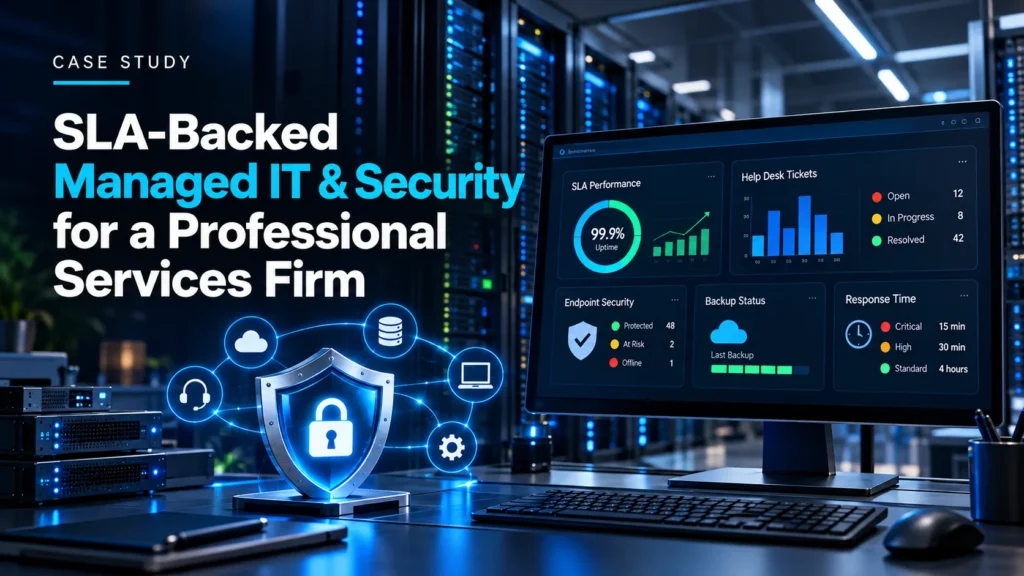
From Break-Fix to Managed IT: Reducing Critical Incidents by 40%

CyberZEALS helped a professional services business move from reactive support to proactive managed IT monitoring, reducing downtime risk and improving operational stability.

CHALLENGE

Frequent unplanned outages, slow incident response, and reliance on break-fix support that left critical systems vulnerable to extended downtime.

SOLUTION

Deployed 24/7 managed monitoring, automated alerting, structured help desk operations, and proactive maintenance schedules across all IT infrastructure.

RESULT

Achieved a 40% reduction in critical incidents within 6 months, with faster response times and measurably improved system reliability.

Explore Our Case Studies

Real projects, real outcomes — see how CyberZEALS delivers measurable IT improvements across industries.
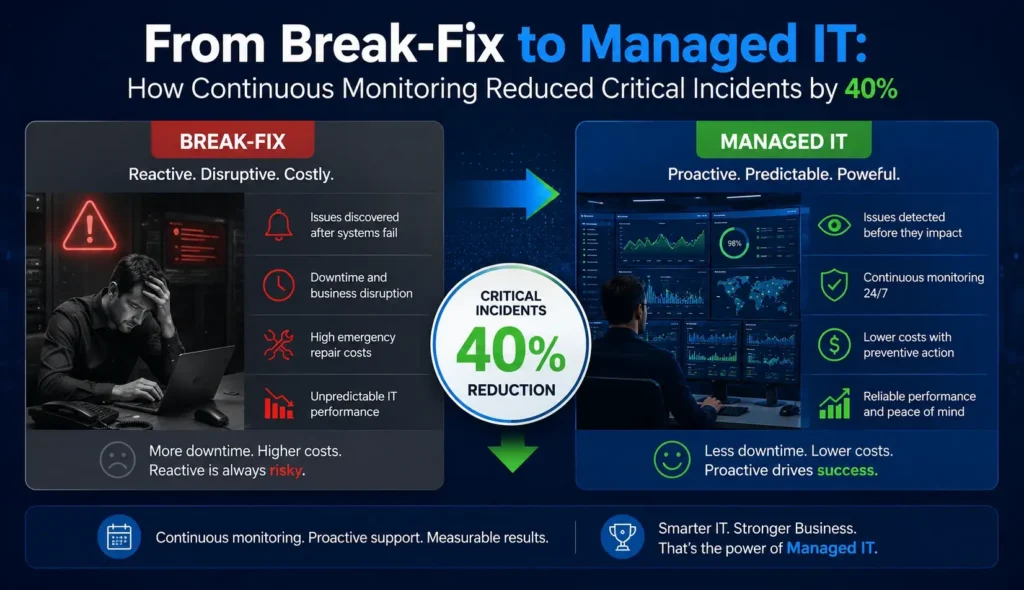
From Break-Fix to Managed IT

From Break-Fix to Managed IT: How Continuous Monitoring Reduced Critical Incidents by 40%

1. Client Background

The client is a mid-sized professional services firm that relies heavily on email, collaboration tools, and line-of-business apps to serve its customers. Rapid growth over the last few years led to a more complex IT environment, including remote workers and multiple office locations. Their small internal IT team was overwhelmed and operated mostly in a reactive, “firefighting” mode.
2. Challenges (Before Managed IT)

Before partnering with the managed service provider, the client followed a traditional break-fix model, calling for support only when something went wrong. This created several pain points:

  • Frequent, unplanned outages of critical systems during business hours.
  • No centralized monitoring, so issues were often detected only after users complained.
  • Inconsistent patching and outdated software, increasing security and stability risks.
  • Overworked internal IT staff with no time for strategic projects.
  • Poor visibility into overall IT health, incident trends, and root causes.

These problems translated into delayed client deliverables, frustrated employees, and a growing concern from leadership about the risk of a major outage.

3. Objectives and Requirements

Together, the client and the provider defined clear objectives for moving from break-fix to a managed IT model:

  • Reduce the number and severity of critical IT incidents.
  • Detect and resolve issues proactively before they impact users.
  • Standardize patching, updates, and maintenance activities.
  • Free up the internal IT team to focus on strategic initiatives rather than daily firefighting.
  • Provide management with clear reporting on system health and incident trends.

4. Consulting Approach

The engagement began with a structured assessment to understand the current state and design the right managed services model:

  • Conducted a full infrastructure and endpoint assessment (servers, network, endpoints, cloud services).
  • Reviewed existing incident history, support tickets, and outage logs.
  • Identified recurring failure points and gaps in monitoring, patching, and backup processes.
  • Defined service levels (SLAs), response times, and escalation paths.
  • Created a phased roadmap to transition from break-fix to continuous monitoring and managed services.

This consultative approach ensured that the solution aligned with both technical requirements and business priorities.

5. Solution Implemented

The provider implemented an integrated managed IT services solution with a focus on visibility, stability, and proactive intervention.

Infrastructure and Monitoring

  • Deployed an RMM (Remote Monitoring and Management) platform across servers, network devices, and endpoints.
  • Configured real-time alerts for CPU, memory, disk usage, network performance, and critical services.
  • Set up health checks and automated scripts to resolve common, low-level issues before they escalated.

Patch Management and Maintenance

  • Implemented a standardized patching policy for operating systems and key applications.
  • Scheduled maintenance windows to apply updates outside business hours.
  • Introduced automated reporting to verify patch compliance and highlight exceptions.

Helpdesk and Operations

  • Established a 24/7 helpdesk with defined SLAs for incident response and resolution.
  • Integrated ticketing with the monitoring platform so that alerts automatically created tickets.
  • Implemented clear incident categorization and prioritization, ensuring critical issues received immediate attention.

Security and Resilience Enhancements

  • Strengthened endpoint protection and centralized antivirus/EDR management.
  • Reviewed backup and recovery procedures and tested restoration of critical systems.
  • Documented standard operating procedures (SOPs) and escalation workflows for major incidents.

6. Results and Metrics

Within the first 6 months of transitioning to the managed IT model, the client experienced significant improvements:

  • Critical incidents (P1 issues) dropped by approximately 40%, as many problems were detected and resolved before impacting users.
  • Average downtime per incident decreased by about 35%, thanks to faster detection, clear SLAs, and predefined response steps.
  • Response and resolution times improved by roughly 25%, supported by 24/7 monitoring and a dedicated helpdesk.
  • Patch compliance increased to over 90% of systems within standard timelines, reducing vulnerability to known issues.
  • The internal IT team recovered several hours per week previously lost to repetitive firefighting, enabling them to focus on strategic projects like application upgrades and user training.

These measurable outcomes translated into smoother day-to-day operations, fewer disruptions for staff, and greater confidence from leadership in the stability of their IT environment.

7. Client Quote or Testimonial

“Before this partnership, our IT team spent most of their time reacting to emergencies. Now, most issues are handled before our employees even notice. We’ve had far fewer outages, and when something does happen, it’s resolved quickly and professionally. This shift to managed IT has been a game changer for our business.”

8. Visuals and Technical Artifacts (Optional)

For your actual website case study, you can support the story with:

  • A simple “Before vs After” diagram showing the move from ad-hoc support to centralized monitoring and managed services.
  • A small chart showing the decline in critical incidents over 6–12 months.
  • A sample dashboard screenshot (anonymized) showing system health, alerts, and ticket stats.

9. Call to Action

If your business is still relying on a break-fix model and dealing with unexpected outages, it may be time to switch to proactive managed IT. Contact our team to schedule a free infrastructure and monitoring assessment and see how continuous monitoring can reduce your critical incidents and downtime.

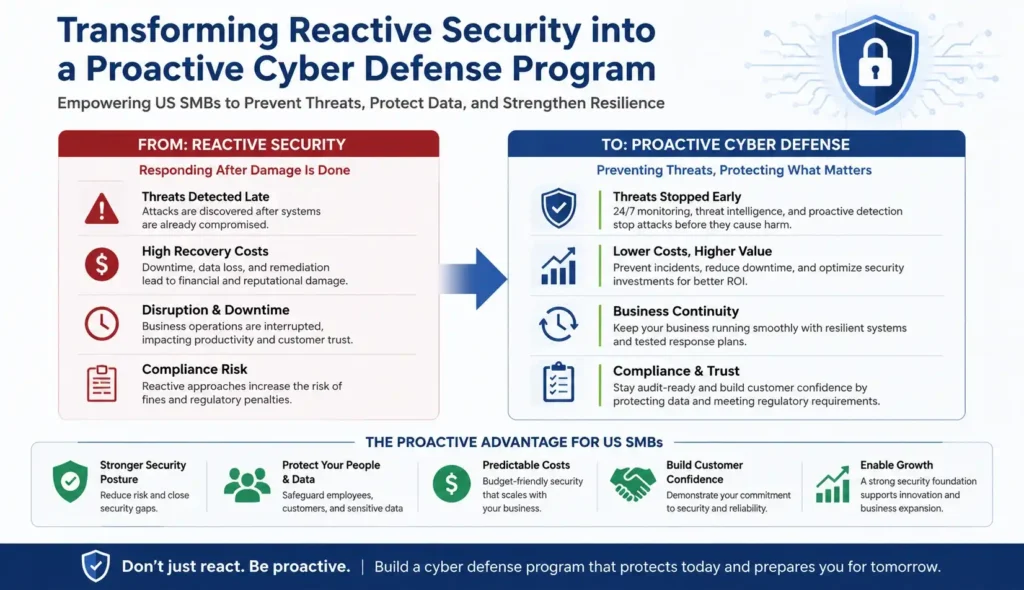
Transforming Reactive Security into a Proactive Cyber Defense

Transforming Reactive Security into a Proactive Cyber Defense Program for a US SMB

1. Client Background

The client is a growing professional services firm that handles sensitive customer data and relies on digital tools for day-to-day operations. As they expanded, their attack surface grew: more cloud apps, more remote workers, and more data flowing between systems. Security had been handled informally by the internal IT generalist, with no dedicated security function or formal program.
2. Challenges (Before Proactive Cyber Defense)

Before engaging the cybersecurity team, the organization operated in a reactive mode, responding to issues only after they became obvious problems. Key challenges included:

  • Sporadic antivirus alerts and phishing attempts handled on a best-effort basis.
  • No centralized visibility into endpoints, user behavior, or network traffic.
  • Inconsistent patching and outdated systems, creating exploitable vulnerabilities.
  • Lack of documented security policies, incident response plans, or user training.
  • Growing concern from leadership after near-miss incidents and increasing cyber insurance requirements.

This reactive approach left the business exposed to data breaches, ransomware, and reputational damage, while also making it difficult to demonstrate security maturity to clients and insurers.

3. Objectives and Requirements

Together, the client and cybersecurity provider defined clear objectives for building a proactive cyber defense program:

  • Move from ad-hoc, reactive security to a structured, continuous defense approach.
  • Gain real-time visibility into threats across endpoints, identities, email, and cloud services.
  • Reduce the likelihood and impact of successful phishing, malware, or ransomware attacks.
  • Establish security policies, standards, and an incident response playbook.
  • Strengthen the client’s security posture to meet customer, partner, and insurance expectations.

4. Consulting Approach

The engagement followed a phased, consultative approach:

  • Performed a comprehensive security assessment covering infrastructure, endpoints, identity management, email, and cloud services.
  • Reviewed logs, past incidents, and existing security tools to identify gaps and overlaps.
  • Conducted stakeholder workshops with IT, leadership, and key business owners to understand risk tolerance and critical assets.
  • Prioritized risks and mapped them to a practical roadmap aligned with industry best practices (e.g., CIS Controls, NIST-style principles).
  • Designed a right-sized security operating model for an SMB, including roles, responsibilities, and escalation paths.

This approach ensured the security program was both effective and realistic for the client’s size, budget, and internal capabilities.

5. Solution Implemented

The solution combined technology, process, and people to create a proactive cyber defense program.

Threat Detection and Monitoring

  • Implemented a managed detection and response (MDR) platform to collect and analyze logs from endpoints, servers, and cloud services.
  • Configured correlation rules and alerts for suspicious activities such as unusual logins, privilege escalation, lateral movement, and data exfiltration.
  • Established 24/7 monitoring with a security operations team to investigate and respond to high-priority alerts.

Endpoint, Email, and Identity Security

  • Deployed advanced endpoint protection/EDR across all workstations and servers.
  • Hardened email security with anti-phishing, attachment scanning, and URL protection.
  • Enforced multi-factor authentication (MFA) for remote access and critical applications.
  • Standardized configuration baselines and implemented least-privilege access for users and admins.

Policies, Governance, and Incident Response

  • Developed and formalized key security policies (acceptable use, access control, password/MFA, incident response, backup and recovery).
  • Created an incident response plan with defined roles, communication flows, and decision points.
  • Conducted tabletop exercises to rehearse response to phishing, ransomware, and data loss scenarios.

Security Awareness and Culture

  • Launched an ongoing security awareness program with short, targeted training modules.
  • Ran simulated phishing campaigns to measure and improve user resilience.
  • Provided tailored guidance for high-risk groups such as finance, HR, and executives.

6. Results and Metrics

Within the first 9-12 months, the organization saw measurable improvements in its security posture:

  • Security incidents that disrupted business operations dropped by around 60%, as many threats were detected and contained early.
  • Mean time to detect (MTTD) potential threats decreased from several days (or never detected) to under 30 minutes for high-severity alerts.
  • Mean time to respond (MTTR) improved significantly thanks to predefined playbooks and a dedicated security response team.
  • Phishing simulation failure rates declined steadily as employees became more aware and vigilant.
  • The company successfully passed an external security assessment required by a major client and met new cyber insurance requirements without major remediation demands.

These outcomes gave leadership greater confidence in their ability to withstand cyber threats and use security as a business enabler rather than a constant worry.

7. Client Quote or Testimonial

“We used to hear about security only when something went wrong. Now, we have clear visibility, regular reports, and a partner watching our environment 24/7. Incidents are fewer, and when they do happen, they’re handled quickly and professionally. Our clients and insurers can see that we take cybersecurity seriously.”

8. Visuals and Technical Artifacts (Optional)

For your website case study, you can enhance this story with:

  • A simple diagram of the new cyber defense architecture (users → endpoints → MDR/EDR → SOC).
  • A before/after timeline showing improvements in detection and response times.
  • An anonymized sample of a monthly security report summarizing alerts, incidents, and training progress.

9. Call to Action

If your business is still handling security on a reactive, “as-needed” basis, you may be exposed to threats you cannot see. Get in touch to schedule a cybersecurity assessment and learn how a proactive cyber defense program can reduce your risk, improve visibility, and satisfy client and insurance requirements.

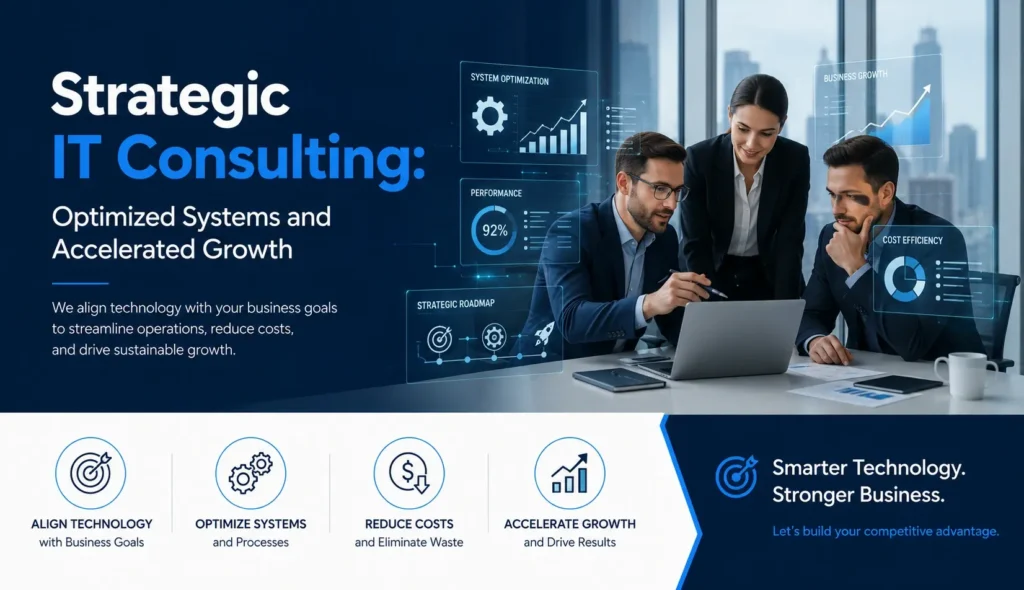
Strategic IT Consulting

Strategic IT Consulting: Optimized Systems and Accelerated Growth

About the Client

The client operates multiple distribution centers and retail outlets across several states. Their operations rely heavily on ERP systems, inventory management platforms, CRM tools, financial systems, and internal communication software. Rapid expansion placed significant pressure on their existing IT infrastructure.
The Challenge

Fragmented Systems Limiting Growth

As the organization expanded, its IT environment became increasingly inefficient and disconnected. Core systems lacked proper integration, performance degraded under growing workloads, and reporting inconsistencies slowed executive decision-making.

Key Issues Identified

  • Legacy on-premise servers struggling under increased demand
  • Disconnected ERP, CRM, and accounting systems
  • Frequent performance slowdowns during peak operational hours
  • Limited visibility into real-time operational data
  • Rising cybersecurity concerns due to outdated configurations
  • High infrastructure maintenance costs

Business Impact

  • Inventory mismatches across distribution centers
  • Delayed leadership reporting cycles
  • Reduced employee productivity
  • Increased downtime affecting customer orders
  • Elevated exposure to cybersecurity risks

Leadership recognized that without a structured IT modernization strategy, continued growth would further strain operations and reduce efficiency.

The Solution

CyberZEALS implemented a comprehensive strategic IT transformation initiative focused on modernization, integration, security, and scalability.

Services Delivered

  • Enterprise-wide IT infrastructure audit
  • Cloud migration strategy and phased implementation
  • Cross-system integration and workflow automation
  • Cybersecurity hardening and access governance
  • Performance optimization across infrastructure and applications
  • Ongoing IT governance and monitoring framework

Our Strategic Approach


1. Infrastructure Assessment

A detailed audit of servers, database performance, network configurations, and application dependencies was conducted. Bottlenecks, redundancies, and inefficiencies were identified and prioritized for remediation.

2. Cloud Migration & Modernization

Legacy on-premise systems were migrated to a scalable cloud infrastructure. Auto-scaling capabilities were configured to handle peak operational demand while improving cost efficiency.

3. System Integration & Automation

ERP, CRM, inventory, and finance platforms were integrated into a centralized ecosystem. Manual reporting processes were replaced with automated dashboards, improving operational transparency and speed.

4. Cybersecurity Enhancement

  • Multi-layer firewall protection implemented
  • Least-privilege access model enforced
  • Endpoint protection solutions deployed
  • Centralized logging and monitoring established

5. Performance Optimization

  • Database query optimization
  • Server load balancing
  • Network performance tuning
  • Application response time improvements

Implementation Process


Step 1: Strategic Roadmap Development

Identified high-risk systems and created a phased modernization roadmap aligned with business priorities.

Step 2: Controlled Deployment

Executed migration and integration in structured phases to avoid operational disruption.

Step 3: Performance Testing & Benchmarking

Measured system performance before and after optimization to validate improvements.

Step 4: Monitoring & Continuous Improvement

Implemented monitoring dashboards and established ongoing governance reviews to ensure sustained performance.

Technologies Utilized

  • Cloud Infrastructure Platform (AWS/Azure equivalent)
  • Enterprise ERP System
  • CRM Platform
  • Centralized Monitoring & Logging Tools
  • Endpoint Security & Access Management Solutions
  • Database Performance Monitoring Tools

Results

Quantifiable Improvements

  • 45% improvement in application performance
  • 60% reduction in downtime incidents
  • 30% faster reporting cycles
  • 25% increase in employee productivity
  • 35% reduction in infrastructure maintenance costs

Security & Compliance Gains

  • Reduced vulnerability exposure
  • Improved audit readiness
  • Strengthened access governance
  • Faster anomaly detection

Business Growth Impact

  • Enabled smooth expansion into two new locations
  • Improved customer order processing speed
  • Enhanced leadership visibility through real-time dashboards
  • Increased operational scalability without proportional IT cost increases

Conclusion

Strategic IT consulting transformed the client’s fragmented infrastructure into a scalable, secure, and optimized technology ecosystem. By aligning IT systems with business objectives, the organization shifted from reactive troubleshooting to proactive, growth-driven operations.

Technology evolved from an operational bottleneck into a competitive advantage.

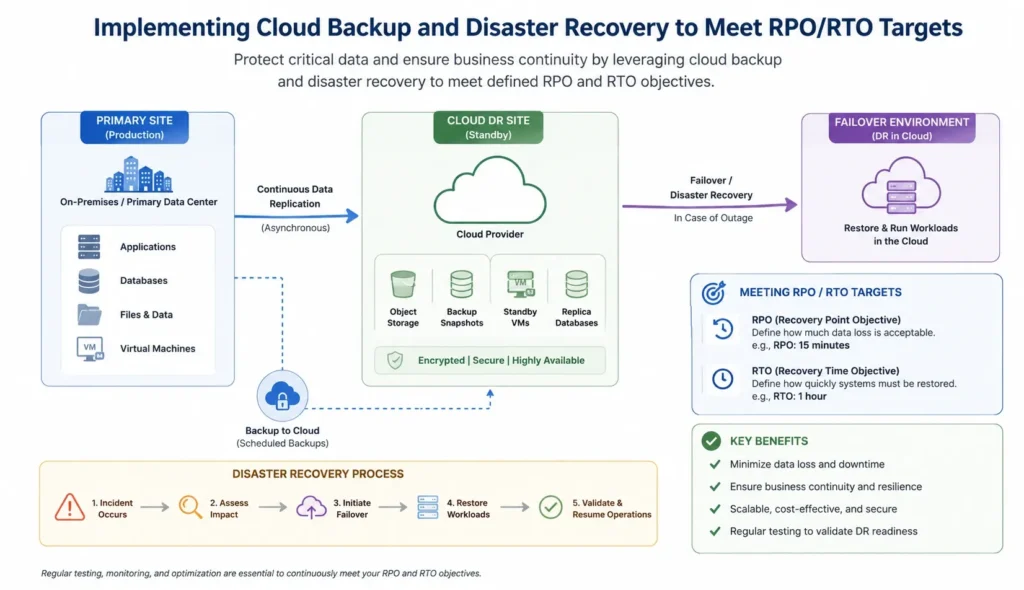
Implementing Cloud Backup and Disaster Recovery to Meet RPO/RTO Targets

Implementing Cloud Backup and Disaster Recovery to Meet RPO/RTO Targets

1. Client Background

The client is a regional healthcare provider that depends on electronic medical records (EMR), imaging systems, and scheduling platforms to deliver patient care.​
They were hosting most core systems on‑premises, with growing use of cloud services for collaboration and file sharing.​
Because of regulatory and contractual requirements, they needed to demonstrate a robust, testable disaster recovery capability.

2. Challenges (Before Cloud DR)

Before the engagement, backup and recovery were handled through traditional nightly backups to local storage and periodic copies to removable media.
Key issues included:

  • RPO of 24 hours or more due to once‑a‑day backups, risking a full day of data loss in an outage.
  • RTO measured in many hours or days, requiring manual restore of servers and applications.
  • No formal Business Impact Analysis (BIA) to map applications to business‑driven RPO/RTO needs.​
  • Limited offsite resilience: a site‑level failure could render both production and local backups unavailable.​
  • DR testing was rare and disruptive, so leadership had low confidence in actual recoverability.

These gaps put both patient care continuity and compliance posture at risk in the event of a major outage or ransomware attack.

3. Objectives and Requirements

Together with the client, the consulting team set clear objectives:

  • Define business‑aligned RPO and RTO targets for each major application through a structured BIA.
  • Implement cloud‑based backup and disaster recovery capable of meeting a 30‑minute RPO and 4‑hour RTO for critical systems.
  • Reduce reliance on manual processes and on‑premises‑only backup infrastructure.
  • Enable regular, low‑risk DR testing to prove readiness to regulators, auditors, and cyber insurers.

4. Consulting Approach

The engagement followed a phased methodology:

  • Performed a Business Impact Analysis to classify applications as mission‑critical, business‑critical, and non‑critical and assign appropriate RPO/RTO ranges.
  • Conducted an infrastructure audit to understand dependencies among servers, storage, network, and cloud services.​
  • Reviewed existing backup jobs, retention policies, and prior restore attempts to baseline current capabilities.​
  • Evaluated cloud DR patterns (backup to cloud, DR to cloud, multi‑site) against the client’s risk tolerance and budget.
  • Designed a hybrid cloud DR architecture combining local performance with cloud‑based resilience and automation.

This ensured the solution was tailored to both clinical priorities and financial constraints.

5. Solution Implemented

The implemented solution combined backup modernization, cloud DR, and orchestration.

Cloud Backup and Replication

  • Deployed Backup‑as‑a‑Service (BaaS) to send encrypted backups from on‑prem systems to a secure cloud repository.
  • Increased backup frequency for critical databases to every 15 minutes using snapshots and log‑based replication to achieve sub‑30‑minute RPO.
  • Implemented separate, immutable backup copies to protect against ransomware and accidental deletion.

Disaster Recovery as a Service (DRaaS)

  • Implemented DRaaS to recover mission‑critical workloads onto virtual machines in the cloud in case the primary site is unavailable.
  • Designed an active‑passive cloud DR configuration with pre‑provisioned network, security, and application stacks to meet 4‑hour RTO.
  • Automated failover workflows and boot‑order sequencing to bring up applications in the correct order (database, services, front‑end).

RPO/RTO‑Driven Policies and Runbooks

  • Mapped backup and replication schedules to the RPO tier of each workload (e.g., 15‑minute replication for EMR, hourly for email, daily for non‑critical systems).
  • Documented DR runbooks specifying responsibilities, decision criteria for failover, and communication plans.
  • Integrated monitoring and reporting dashboards to track backup success rates, replication status, and RPO/RTO compliance.

Testing and Continuous Improvement

  • Conducted initial DR tests simulating loss of the primary data center, measuring actual RTO and RPO for each application.
  • Tuned resource sizing and automation based on test results to consistently achieve the target recovery times.
  • Scheduled regular, non‑disruptive DR exercises and documented outcomes for audit and compliance reviews.

6. Results and Metrics

Within the first year, the client realized clear, measurable gains:

  • Achieved an RPO of less than 30 minutes for critical clinical databases and EMR, compared to 24+ hours previously.
  • Achieved an RTO under 4 hours for the core clinical application stack during DR tests, validated across multiple scenarios.
  • Reduced DR test duration and preparation effort by roughly 50% through automation and standardized scripts.
  • Improved backup success rates and visibility, with centralized reporting on backup and DR health for IT leadership.
  • Strengthened compliance posture, enabling the organization to demonstrate a working DR plan to regulators and partners with documented test evidence.

These improvements significantly reduced the risk of extended downtime impacting patient care and improved confidence in the organization’s resilience strategy.

7. Client Quote or Testimonial

“For years we had backups, but we were never sure how long a real recovery would take. Now we have clear RPO and RTO targets, a cloud‑based DR environment, and regular tests to prove it works. Our leadership and auditors finally have the assurance they were looking for.”

8. Visuals and Technical Artifacts (Optional)

For your website case study, you can add:

  • A high‑level diagram showing production on‑prem, cloud backup, and DRaaS failover environment.
  • A simple table or chart showing before/after RPO and RTO values for key applications.
  • An anonymized screenshot of the DR dashboard tracking backup jobs, replication lag, and test status.

9. Call to Action

If your current backup strategy cannot confidently meet your RPO and RTO targets, your business continuity is at risk.
Contact our team to schedule a disaster recovery readiness assessment and see how cloud backup and DRaaS can help you achieve tested, documented RPO/RTO for your critical workloads.

How CyberZEALS Turns Technical Problems into Measurable Outcomes

A structured, repeatable approach that transforms complex IT challenges into clear results.

01

Access the Risk

We evaluate your current IT environment, identify vulnerabilities, and quantify the operational risk your business faces today.

02

Design the Strategy

Based on findings, we build a tailored roadmap — addressing the highest-impact risks first, aligned with your budget and goals.

03

Implement the Solution

Our team deploys the solution with minimal disruption — configuring, testing, and validating every component before handoff.

 
04

Measure the Impact

We track KPIs, report on outcomes, and continuously optimize — ensuring the solution delivers real, measurable business value.


Industries We Serve

CyberZEALS delivers tailored IT solutions across sectors that demand reliability, compliance, and security.

Professional Services

Law, consulting, accounting

Healthcare

 health tech, providers

Finance

Banks, fintech, insurance

Legal Firms

Corporate law, litigation

Retail

eCommerce, POS, logistics

Technology Companies

SaaS, startups, platforms

Looking For Dependable IT Support Across the USA?

Get professional IT services and solutions designed to support secure scalable business operations without the overhead of building an internal IT department from scratch.

Need Reliable IT Support in USA

Technology Platforms We Work With

Enterprise-grade tools and platforms powering our managed IT, cybersecurity, and cloud solutions.

AWS

Microsoft Azure

Google Cloud

Microsoft 365

Kubernetes

Security Monitoring

What Businesses Across the USA Say About Working With Us

Common Questions About Working With CyberZeals

CyberZeals combines a security-first approach with industry-specific knowledge, giving businesses across the USA an IT partner that understands both their technical needs and their compliance environment  not a generic, one-size-fits-all support contract.

Before any commitment, our IT consulting services in USA team assesses your current infrastructure, identifies gaps, and maps out a realistic technology roadmap  covering network design, cloud architecture, and disaster recovery planning, so you know exactly what you’re investing in.

Yes. Our managed IT services in USA are structured specifically for small and mid-sized budgets  help desk support, proactive maintenance, backup and recovery, and patch management are all available without the cost of building an in-house IT department.

As a managed IT services provider USA companies rely on, we build endpoint protection, 24/7 threat monitoring, regular patching, and compliance-driven audits into every plan from day one, rather than treating security as an optional upgrade.

No. Our cloud support services in USA work across AWS, Microsoft Azure, and Google Cloud, configured around your business’s actual budget and compliance requirements rather than locking you into a single vendor’s ecosystem.

Yes. Our cybersecurity services provider in USA approach is designed around small and mid-sized teams specifically  threat monitoring, penetration testing, and security audits are all scaled to match your existing staffing and risk profile.

We regularly support healthcare, financial services, government contractors, manufacturing, and professional services firms tailoring our cybersecurity service USA work to each industry’s specific regulatory and operational requirements.

Both. Our security audits and compliance services include proactive gap analysis controls identification, and audit management, so businesses operating under HIPAA, CMMC, or PCI-DSS frameworks stay ahead of requirements instead of scrambling during an audit.

Not necessarily. CyberZeals also offers digital marketing services in USA including SEO content writing, PPC and social media marketing  so businesses can manage both technology and growth through a single partner if they choose to.

As a managed service providers in USA partner our monitoring is built to catch most issues before they cause downtime. When something does happen, our support team responds immediately regardless of the hour to limit business impact.

Scroll to Top