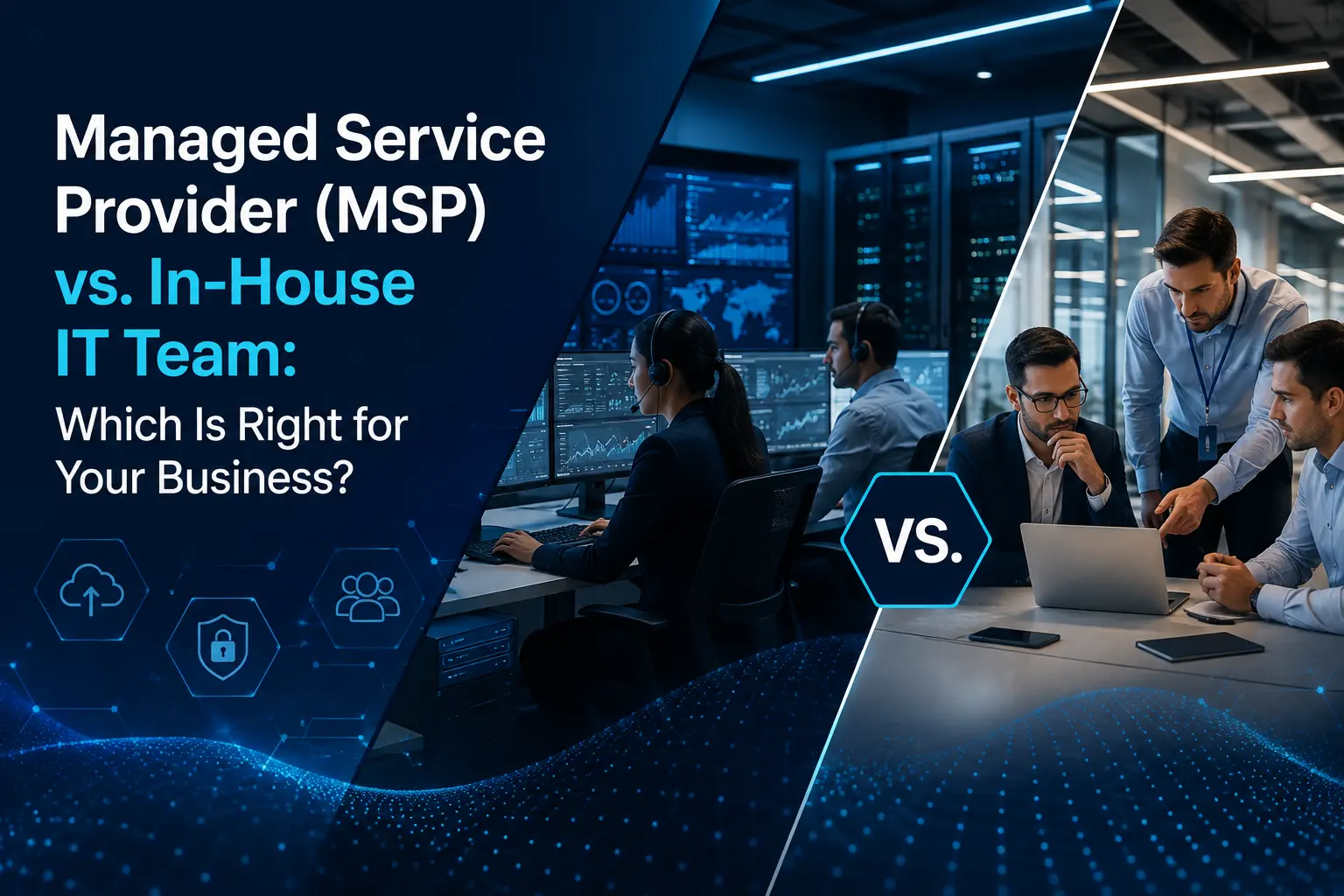
Direct Summary: The main difference between a managed service provider (MSP) and an in-house IT team is their employment and operational model. An in-house IT team consists of direct employees providing dedicated internal control, while a managed service provider (MSP) is an external partner delivering scalable, specialized IT management under a structured service agreement.
An in-house IT team and a managed service provider (MSP) can both help a business manage, secure, and optimize its technology infrastructure. The term “in-house IT staff” refers to dedicated internal employees operating within the organization. These teams possess intimate knowledge of company workflows, staff requirements, daily operational bottlenecks, and overarching business objectives.
A Managed Service Provider (MSP) like CyberZeals is an external IT organization that provides ongoing technical support, infrastructure monitoring, cybersecurity, cloud architecture, and strategic IT planning. For many modern organizations, the optimal approach is not an “either/or” choice; instead, many businesses implement a co-managed IT model that combines internal control with external specialized expertise.

MSP vs. In-House IT at a Glance
Evaluation Area | In-House IT Team | Managed Service Provider (MSP) |
Business Knowledge | Deep, immediate operational knowledge | Structured onboarding; builds over time |
| Technical Skill Depth | Limited to the specific skills of hired staff | Broad access to multi-disciplinary specialists |
Monitoring Capabilities | Typically limited to standard business hours | Continuous 24/7/365 network and security monitoring |
| Cybersecurity Depth | Dependent on internal security expertise | Advanced security tools, SOC access, and threat intelligence |
Cloud Architecture | Maintained internally by existing staff | Specialized cloud engineers across AWS, Azure, and M365 |
| Staffing Model | Direct W-2 hiring, benefits, and training costs | Scalable monthly Service Level Agreement (SLA) |
Direct Control | Absolute direct managerial oversight | Shared responsibility model with defined SLAs |
| Best Fit For | Organizations needing on-site, dedicated control | Organizations needing specialized skills, scale, or 24/7 oversight |
What Does an In-House IT Team Do?
Quick Answer: An in-house IT team functions as an internal department handling daily user requests, device deployment, local network administration, and immediate on-site technical troubleshooting.
Internal IT employees work directly within your organization to maintain day-to-day technological continuity. Primary responsibilities typically include:
- Helpdesk Support: Direct, on-site troubleshooting and employee device onboarding.
- Access Management: Configuring software user accounts, directory permissions, and local networks.
- Vendor Coordination: Interfacing with Internet Service Providers (ISPs) and hardware vendors.
- Internal Systems: Maintaining line-of-business applications and physical server rooms.
The Challenge of Small Internal Teams
When an organization relies on only one or two IT employees, those individuals must simultaneously manage routine helpdesk tickets, cloud migrations, emergency outages, and complex cybersecurity patching. This environment often leads to burnout and forces staff to prioritize immediate daily issues over proactive, long-term security planning.
What Does a Managed Service Provider (MSP) Do?
Quick Answer: A Managed Service Provider (MSP) delivers proactive, subscription-based technology management that offers access to specialized engineering teams that provide 24/7 infrastructure monitoring and enterprise-grade security tools.
An MSP acts as a strategic technology partner, offering comprehensive IT management under a defined Service Level Agreement (SLA). Providers like CyberZeals extend an organization’s capabilities by delivering:
- 24/7 System Monitoring: Automated network and server health tracking.
- Advanced Cybersecurity: Endpoint Detection and Response (EDR), threat hunting, and vulnerability management.
- Cloud Architecture & Management: Administration of Microsoft 365, Google Workspace, Azure, and AWS environments.
- Patch & Backup Oversight: Systematic updating of software and automated verification of data backups.
- Strategic Virtual CIO (vCIO) Services: Long-term technology roadmapping, budget planning, and compliance preparation.
An MSP is particularly valuable when an organization requires advanced technical domain expertise such as penetration testing services, zero-trust cloud configuration, or disaster recovery orchestration—without the expense of hiring multiple full-time executives.
When Does an In-House IT Team Make Sense?
An internal IT team is typically the preferred approach when an organization’s core operations require continuous, physical on-site technical presence.
Key scenarios in which in-house IT excels include the following:
- High Physical Presence Needs: Manufacturing plants, healthcare facilities, or hardware labs requiring immediate hands-on fixes.
- Proprietary Legacy Systems: Highly customized, home-grown software that requires dedicated in-house developers or engineers.
- Large Enterprise Scale: Companies with hundreds or thousands of users where hiring specialized internal teams is financially efficient.
- Strict Internal Control Policies: Management models that require direct daily supervisory oversight over every technical task.
When Does an MSP Make Sense?
Partnering with an MSP like CyberZeals is advantageous for small to mid-sized organizations seeking enterprise-grade IT infrastructure without the high overhead of multiple specialized salaries.
An MSP is the right choice when:
- Internal Staff Is Overwhelmed: Your team spends all their time answering help desk tickets instead of driving strategic projects.
- Skill Gaps Exist: You lack internal experts in complex areas like cloud security architecture, compliance frameworks (e.g., SOC 2, HIPAA, CMMC), or penetration testing.
- 24/7 Coverage Is Required: Your business operates across multiple time zones or cannot afford unmonitored overnight downtime.
- Predictable Budgeting Is Preferred: You want to shift from unpredictable variable capital expenditures (CapEx) to steady, fixed monthly operating expenditures (OpEx).
Can an MSP Work Alongside an Internal IT Team? (Co-Managed IT)
Quick Answer: Yes. A co-managed IT model divides responsibilities between your internal team and an external MSP, allowing internal staff to retain business alignment while leveraging the MSP for complex infrastructure, security, and 24/7 monitoring.
Co-managed IT eliminates the “MSP vs. In-House” debate by creating a strategic partnership. Rather than replacing your internal team, CyberZeals complements existing staff through a defined division of labor.
This hybrid approach allows internal IT staff to focus on driving core business value while leaving overnight alerts, security patch management, and complex cloud maintenance to external specialists.
Specialized Areas Where CyberZeals Extends Your Capabilities
1. Cloud Infrastructure Management
Cloud environments like AWS, Azure, and Microsoft 365 require constant governance. CyberZeals helps businesses optimize user access controls, secure storage containers, monitor virtual machine health, and manage cloud expenditure to prevent cost overruns.
2. Backup and Disaster Recovery (BDR)
A data backup is simply a copy of files; a disaster recovery plan is a documented, tested strategy to restore business operations after a ransomware attack or outage.
CyberZeals implements the 3-2-1-1-0 backup rule:
- 3 copies of critical data
- 2 different media types
- 1 off-site location
- 1 immutable/air-gapped copy (protected against ransomware)
- 0 errors after automated recovery testing
3. Advanced Cybersecurity & Penetration Testing
While routine IT maintenance includes patching and firewall updates, security validation requires specialized testing. CyberZeals provides independent penetration testing across networks, cloud resources, and web applications to identify actionable vulnerabilities before malicious actors can exploit them.
Cost Comparison: MSP vs. In-House IT
Determining cost efficiency requires comparing total cost of ownership (TCO) rather than surface-level costs.
- In-House IT Expenses: In addition to base salaries, internal hiring includes employee taxes, health insurance, retirement contributions, ongoing certification training, and individual software licensing fees for security tools.
- MSP Financial Model: An MSP bundles specialized talent, enterprise security platforms, backup storage, and monitoring tools into a single predictable monthly fee, drastically reducing operational overhead.
Critical Questions to Ask Before Choosing an MSP
When evaluating potential IT management partners, ask these direct questions to verify capability:
- What specific services are covered under the flat monthly fee versus billed as out-of-scope project work?
- What are your guaranteed response time SLAs for critical system outages?
- Is 24/7 threat monitoring handled by a Security Operations Center (SOC)?
- How often are our disaster recovery backups tested for successful restoration?
- How does your team coordinate with our internal staff in a co-managed model?
- What is the off-boarding procedure if we choose to transition services in the future?
Common Myths About Managed IT Services
- Myth 1: “MSPs are only for large enterprises.”
- Fact: Small businesses benefit significantly because an MSP provides access to multi-million-dollar security infrastructures and diverse engineering teams that small budgets could never hire directly.
- Myth 2: “Cloud tools mean we no longer need IT support.”
- Fact: Cloud providers secure the physical infrastructure, but you are responsible for data security, access identity permissions, backup validation, and application configuration under the Cloud Shared Responsibility Model.
- Myth 3: “Hiring an MSP means firing our existing IT staff.”
- Fact: Most MSP partnerships are co-managed, designed to empower and offload routine maintenance from internal teams so they can focus on high-value business initiatives.
FAQs:
What is a Managed Service Provider (MSP)?
A Managed Service Provider (MSP) is an external company that manages a business’s IT infrastructure, software applications, cybersecurity, and cloud environments on an ongoing basis under a structured service agreement.
What is co-managed IT?
Co-managed IT is a collaborative support model where an external MSP works alongside a business’s internal IT department. The internal team handles day-to-day operations and business alignment, while the MSP handles specialized tasks such as 24/7 security monitoring, cloud management, and backup validation.
Are penetration testing services included with standard managed IT?
Penetration testing is typically scoped as an independent security engagement separate from routine managed IT services. It involves structured ethical hacking methodologies, detailed vulnerability reporting, and remediation recommendations.
Does an MSP replace the role of an IT director or CIO?
No. An MSP provides operational execution, technical resources, and virtual CIO (vCIO) recommendations, but internal leadership retains ultimate decision-making power over technology strategy and business alignment.
How CyberZeals Can Help
Whether you need to offload overnight monitoring, validate your cybersecurity posture, or transition to a flexible co-managed IT structure, CyberZeals provides tailored IT consulting, managed support, cloud orchestration, and penetration testing services for growing businesses. Contact us today for a comprehensive technology and security assessment to identify gaps, streamline management, and optimize your overall IT strategy.