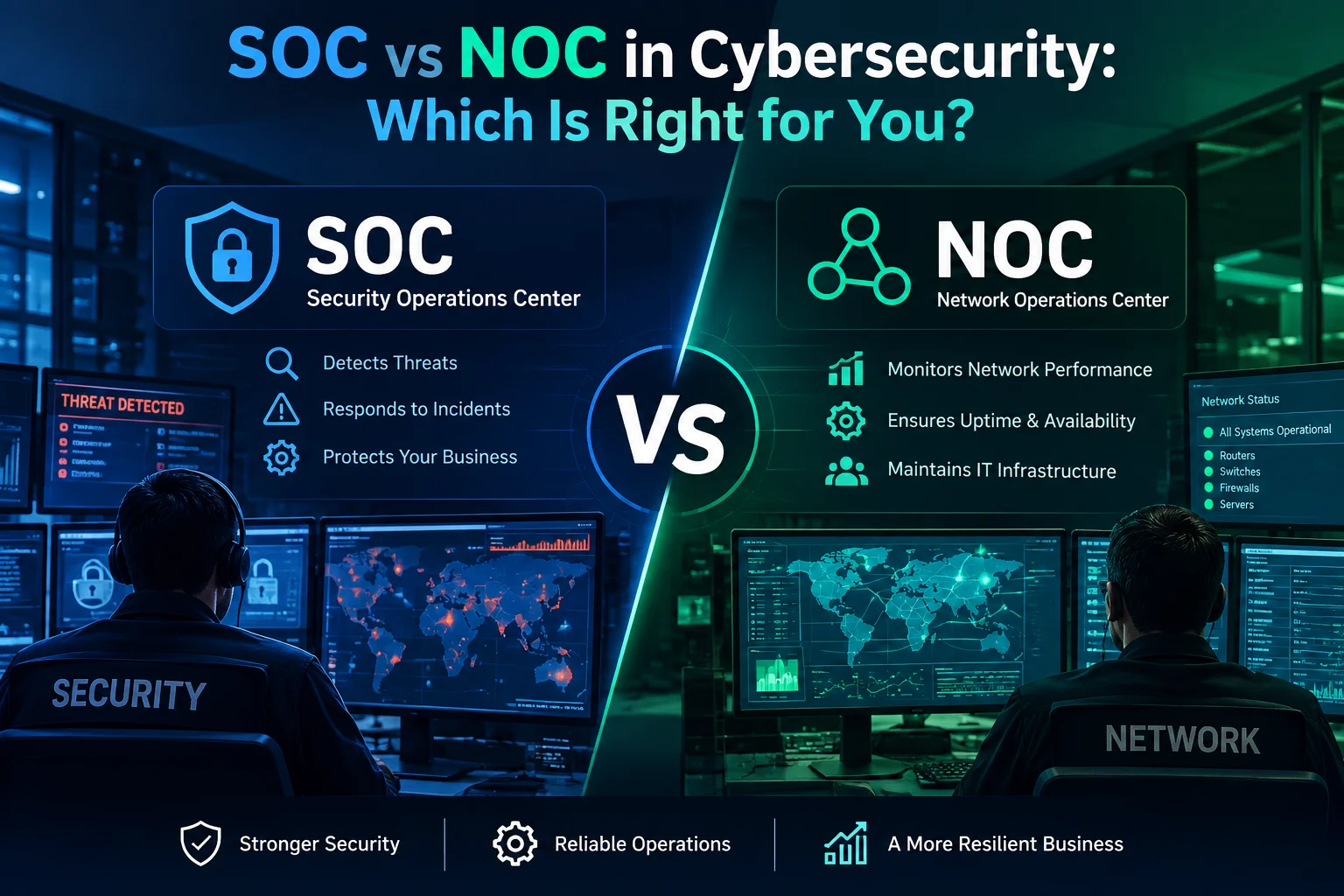
The SOC vs NOC comparison comes down to two different operational priorities. A Network Operations Center focuses on keeping networks, infrastructure, and connected services available and performing properly. A Security Operations Center focuses on detecting, investigating, and responding to cybersecurity threats. The two functions may monitor parts of the same environment, but they are not interchangeable. A NOC is mainly concerned with whether infrastructure is available and performing as expected.
A SOC looks at the environment from a security perspective and asks whether suspicious or malicious activity is taking place. For some organizations, network reliability is the immediate priority. Others need stronger threat visibility and incident response capabilities. Businesses with complex infrastructure and significant security requirements may need both functions working together.

What Is a Security Operations Center (SOC)?
A Security Operations Center, or SOC, is the cybersecurity function responsible for monitoring security activity, investigating suspicious behavior, and coordinating responses to potential threats. If you are asking what does SOC mean in cybersecurity?, the key difference is its security objective. A SOC is not simply determining whether a system works properly. Its analysts are trying to identify malicious behavior, understand its impact, and decide what response is required. SOC visibility can include endpoints, identities, applications, cloud environments,networks, security logs, and other sources of security telemetry.
Core Responsibilities of a SOC
A SOC focuses on detecting, investigating, and responding to cybersecurity threats. Its responsibilities usually center on identifying suspicious activity quickly and reducing the potential impact of security incidents.
- Monitor security alerts and suspicious activity.
- Triage and prioritize security events.
- Investigate potential threats and compromised accounts.
- Escalate confirmed incidents for further response.
- Support containment and remediation activities.
- Perform threat hunting and deeper analysis where required.
- Maintain security reporting and incident documentation.
Common SOC Tools and Security Metrics
SOC teams rely on security monitoring and investigation tools to collect signals, detect threats, and understand suspicious activity across the environment.
- Security Information and Event Management (SIEM).
- Endpoint Detection and Response (EDR).
- Intrusion detection and prevention tools.
- Threat intelligence platforms.
- Security analytics and investigation tools.
- Metrics such as detection time, response time, false-positive rate, investigation efficiency, and incident resolution.
See More: What Is a SOC Report?
What Is a Network Operations Center (NOC)?
A Network Operations Center, or NOC, is a centralized function responsible for monitoring and maintaining network and infrastructure performance. If you are wondering what does NOC mean in cybersecurity?, think of it as the operational team responsible for keeping the technology environment stable, available, and reliable. A NOC can notice unusual network behavior, but dedicated cybersecurity investigation is not its primary responsibility. NOC teams typically monitor networks, servers, connectivity, infrastructure devices, bandwidth, and service availability. When something fails or performance drops, they investigate the cause and work to restore normal operations.
Core Responsibilities of a NOC
A NOC focuses on keeping networks, infrastructure, and connected services stable and available. Its responsibilities usually center on identifying operational issues before they create wider disruption.
- Monitor network availability and infrastructure health.
- Investigate connectivity and performance problems.
- Troubleshoot device, server, and routing issues.
- Track bandwidth, capacity, and resource usage.
- Respond to outages and service degradation.
- Coordinate infrastructure maintenance and escalation.
Common NOC Tools and Performance Metrics
NOC teams use monitoring and management tools to understand how infrastructure is performing and where operational problems are developing.
- Network and infrastructure monitoring platforms.
- Traffic and performance analysis tools.
- Observability platforms.
- Configuration management systems.
- Ticketing and incident management tools.
- Metrics such as uptime, availability, latency, bandwidth utilization, outage frequency, and restoration time.
NOC vs SOC Difference: Key Areas Compared
The main NOC vs SOC difference is purpose. A NOC concentrates on operational availability and infrastructure performance, while a SOC concentrates on cybersecurity threats and security incidents. That distinction influences what each team monitors, the tools it uses, the incidents it handles, and how performance is evaluated.
| Factor | NOC | SOC |
| Primary focus | Network and infrastructure availability | Cybersecurity threats and security events |
| Main objective | Keep technology operational | Detect, investigate, and respond to threats |
| Monitoring scope | Networks, servers, connectivity, devices | Endpoints, identities, logs, cloud, networks, security events |
| Common issues | Outages, latency, capacity problems, device failures | Malware, compromised accounts, suspicious activity, attacks |
| Typical tools | Network and infrastructure monitoring platforms | SIEM, EDR, threat intelligence, security tools |
| Key metrics | Uptime, latency, availability, restoration time | Detection, response, alert quality, incident handling |
| Typical response | Troubleshoot and restore service | Investigate, contain, escalate, and support remediation |
The distinction is clear, but the boundaries can overlap. A performance problem may have a security cause, while a security response may affect service availability.
NOC vs SOC Monitoring: Same Environment, Different Priorities
The NOC vs SOC monitoring difference becomes easier to understand when both teams are looking at the same technical event. They may receive information from the same infrastructure, but they interpret that information according to different operational objectives.
How a NOC Views Network Activity
Imagine network traffic suddenly increases and a customer-facing application begins running slowly. The NOC may check bandwidth consumption, latency, routing, server performance, device health, and capacity. Its immediate concern is determining why service has degraded and how normal performance can be restored. If the cause is a failed network device, overloaded server, or configuration issue, the problem remains primarily operational.
How a SOC Views the Same Activity
The SOC may examine that same traffic spike and ask a different set of questions. Could the traffic indicate a denial-of-service attack? Is a compromised system communicating externally? Is there unusual outbound data movement? Could an attacker be scanning systems for weaknesses? The NOC sees the effect on availability. The SOC investigates whether malicious activity is causing or contributing to that effect. This is why shared telemetry and clear communication between the two teams can be valuable.
How SOC and NOC Teams Work Together During Incidents
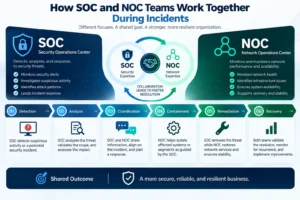
SOC and NOC teams often need to cooperate when an incident affects both security and availability. A NOC may be the first team to notice unexplained service degradation, abnormal traffic, or unusual infrastructure behavior. If the issue appears suspicious, the team can escalate it to security and provide network context that helps the SOC investigate. The opposite can also happen. A SOC may confirm that a server or endpoint is compromised and request network-level containment. The NOC or infrastructure team may then need to isolate systems, change routing, block traffic, or support other actions.
DDoS attacks are a clear example of this overlap. The NOC may see bandwidth pressure and service disruption, while the SOC investigates whether the traffic is malicious and whether other indicators suggest a wider attack. Effective collaboration requires clear ownership, escalation criteria, communication channels, and handoff procedures. The objective is not to turn the NOC into a SOC or the SOC into a NOC. It is to prevent operational and security issues from getting stuck between teams.
SOC vs NOC: Which Is Better for Your Organization?
When businesses ask NOC vs SOC which is better, there is no universal winner. The two functions address different risks. The right choice depends on what your organization needs to monitor, protect, and keep available.
When a NOC Should Be a Priority
A NOC may be the priority when the business depends heavily on network reliability,infrastructure performance, and continuous service availability. Organizations with distributed locations, large networks, customer-facing digital services, complex infrastructure, or demanding uptime requirements need strong visibility into outages and performance problems. In this case, the main concern is keeping technology reliable and accessible.
When a SOC Should Be a Priority
A SOC should receive greater attention when an organization needs stronger cybersecurity monitoring, threat visibility, investigation, and incident response. Businesses handling sensitive data, using cloud infrastructure, supporting remote users, operating internet-facing systems, or facing regulatory requirements may need more structured security monitoring capabilities. Here, the concern is not simply whether systems are online. It is whether users, systems, and data are being targeted or compromised.
When You Need Both SOC and NOC Capabilities
Many organizations need both capabilities because availability and security are closely connected. A network can remain available while an attacker operates inside it. A business can also have strong security monitoring while still suffering from recurring outages or infrastructure problems. Having both capabilities does not necessarily require two large internal operations centers. Businesses can combine internal teams, managed services, shared tooling, and specialist providers based on their size, risk, and operational requirements.
In-House vs Outsourced SOC and NOC Operations
SOC and NOC functions can be managed in-house, outsourced, or through a hybrid model. The right choice depends on staffing, expertise, coverage, security risk, and infrastructure complexity.
| Model | Best For | Main Consideration |
| In-House | Greater control & internal visibility | Requires skilled staff & resources |
| Outsourced | Access to external expertise & coverage | Scope and escalation must be clear |
| Hybrid | Shared internal & external responsibilities | Strong coordination is essential |
How CyberZeals Supports SOC and NOC Security for Your Business?
Choosing between SOC and NOC capabilities starts with understanding your security risks, monitoring gaps, and operational priorities. CyberZeals helps organizations assess these areas and identify where stronger security controls or visibility may be needed. These services can help organizations understand whether their current monitoring approach provides enough security visibility and where SOC-related capabilities may need to be strengthened.
Relevant services include:
- Cybersecurity Risk Assessments to identify security exposure and priority risks
- Security Audits to review existing controls and security processes
- Penetration Testing to test how exploitable those weaknesses may be
- Cybersecurity Services to improve security strategy and operational readiness
- Compliance Readiness and Remediation Planning to address gaps and strengthen controls
FAQs
Can a Business Use a SOC Without a NOC?
Yes. Some organizations have dedicated security monitoring while network operations remain with internal IT teams or another provider.
Does a SOC Replace IT Operations?
No. A SOC handles security threats, while IT operations and NOC teams focus on infrastructure performance and availability.
How Do SOC and NOC Teams Work During Attacks?
The SOC investigates the threat, while the NOC supports network stability, service availability, and infrastructure changes.
Do Cloud Environments Need Both SOC and NOC?
Often, yes. Cloud environments create both performance and security monitoring needs, although responsibilities may be handled through different teams or providers.
What Should You Check Before Outsourcing SOC or NOC?
Review monitoring scope, response responsibilities, escalation procedures, reporting, coverage, and ownership during incidents.
When Should SOC and NOC Be Separate?
Separate functions make more sense as infrastructure complexity, security risk, compliance needs, and monitoring requirements increase.