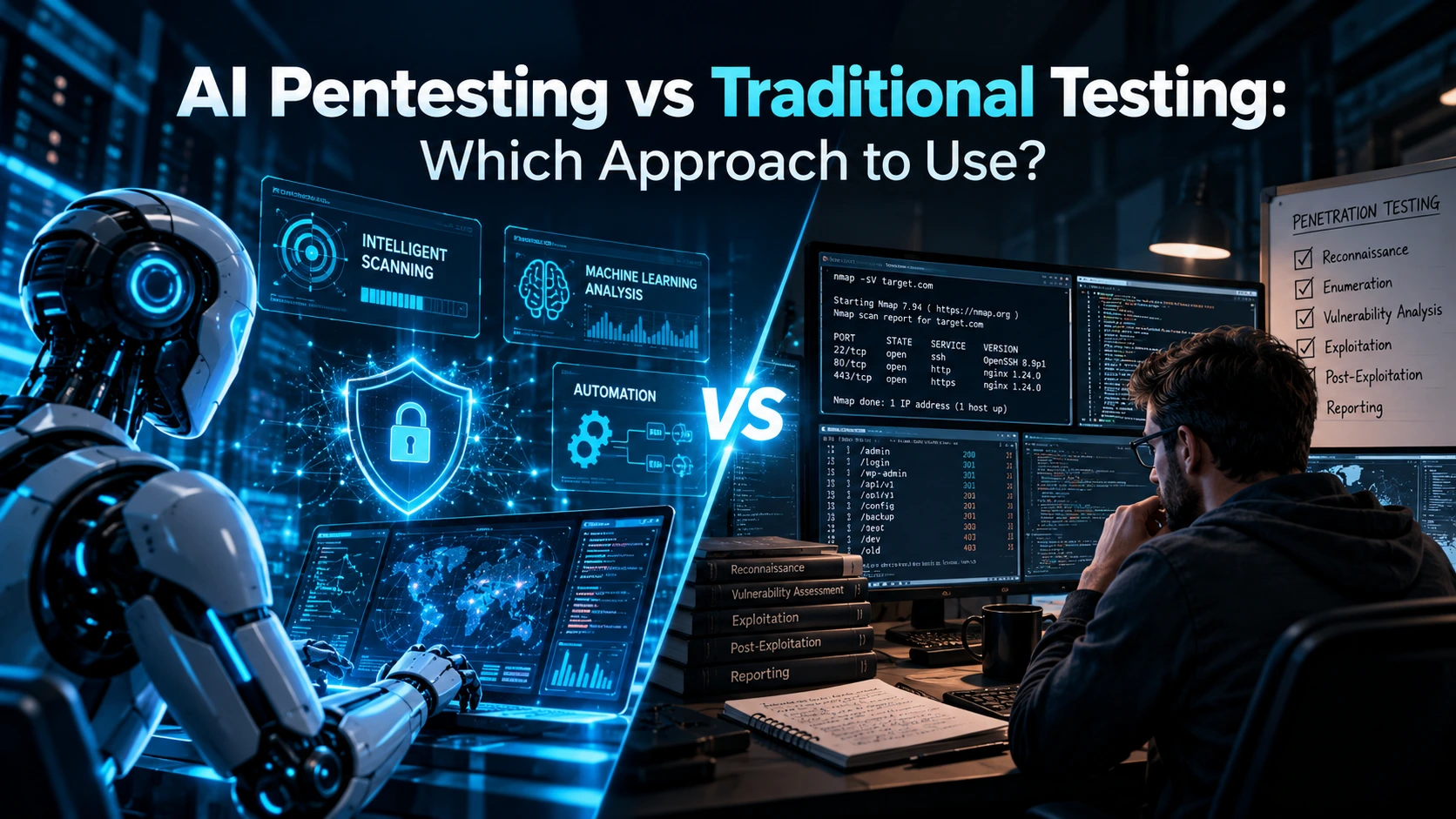
As cyber threats become more sophisticated and technology environments grow more complex, organizations need faster and more effective ways to uncover security weaknesses. The debate around AI Pentesting vs traditional penetration Testing is becoming increasingly important as businesses evaluate how automation and human expertise fit into their security strategies. AI-powered testing can automate repetitive tasks, process large amounts of security data, and identify potential vulnerabilities quickly, while traditional penetration testing relies on experienced security professionals to investigate complex attack paths and validate real-world risks.
Understanding the strengths and limitations of each approach helps organizations choose the testing method that best matches their infrastructure, security objectives, and risk profile.

What Is AI Penetration Testing?
AI penetration testing services is a security testing approach that uses artificial intelligence to help identify vulnerabilities in systems, applications, and networks. It helps security teams analyze potential risks faster by automating certain testing activities and improving the way security data is reviewed. AI-assisted penetration testing can support tasks such as vulnerability discovery, security analysis, and risk prioritization.
However, AI does not replace the complete penetration testing process. Security professionals are still needed to validate findings, understand the impact of vulnerabilities, and make accurate security decisions.
What Is Traditional Penetration Testing?
Traditional penetration testing is a human-led security assessment where ethical hackers evaluate systems, applications, networks, and infrastructure to identify vulnerabilities. Security professionals use manual testing techniques, industry methodologies, and technical expertise to simulate real-world attacks. Unlike automated approaches, traditional penetration testing relies heavily on human judgment and creativity.
Testers analyze how systems behave, explore different attack paths, and determine how identified weaknesses could affect business operations. This approach is especially valuable when testing complex environments that require deeper analysis and contextual understanding.
AI Pentesting vs Traditional Penetration Testing: Key Differences
Organizations are looking for faster and more efficient ways to identify security weaknesses as their technology environments become more complex. Artificial intelligence is introducing new capabilities that help security teams automate certain testing activities and analyze security information more efficiently. However, choosing the right testing approach depends on more than speed and automation.
Businesses need to consider their security goals, system complexity, and the level of expertise required to identify and validate vulnerabilities. Comparing AI pentesting vs. traditional penetration testing helps organizations understand where each approach provides the most value.
Factor | AI Pentesting | Traditional Penetration Testing |
Testing approach | AI-assisted automation | Human-led assessment |
Speed | Faster vulnerability discovery | More time-intensive |
Analysis | Pattern-based analysis | Human reasoning and creativity |
| Accuracy | Depends on models & available data | Depends on tester expertise |
| Complex attacks | Limited in certain scenarios | Better for advanced attacks |
| Reporting | Automated insights | Detailed expert analysis |
How AI Improves Traditional Penetration Testing?
AI is not only changing penetration testing through automation. It is also becoming a supporting technology that helps security professionals improve the speed, accuracy, and efficiency of their assessments. By handling repetitive tasks and analyzing large amounts of security data, AI allows testers to focus more on complex analysis and decision-making.
Faster Reconnaissance
AI can help security teams collect and analyze information during the early stages of penetration testing. Automated analysis can speed up the process of identifying potential targets, reviewing available data, and highlighting areas that may require deeper investigation.
Automated Scanning
AI-assisted tools can improve vulnerability scanning by analyzing systems faster and identifying potential weaknesses across larger environments. This helps security teams discover security issues more efficiently while reducing the time required for initial assessments.
Vulnerability Prioritization
AI can help organize security findings based on severity, risk factors, and potential impact. This allows testers to focus on vulnerabilities that require immediate attention instead of spending equal time reviewing every identified issue.
Report Assistance
AI can support penetration testing documentation by helping organize findings, summarize technical information, and improve reporting efficiency. Security professionals can then review and refine reports to ensure accuracy and provide meaningful recommendations.
Attack Simulation Support
AI can assist security teams in analyzing possible attack scenarios and understanding potential security risks. However, expert validation remains necessary to confirm findings and evaluate the real impact of simulated attacks.
The Role Of AI In Modern Penetration Testing
AI is not replacing penetration testing completely. Instead, it is becoming a supporting technology that helps security teams improve testing efficiency and analyze vulnerabilities faster. AI can assist with automation, security analysis, and risk identification. However, it still has limitations when dealing with complex attack scenarios, business context, and unique system behaviors.
Human penetration testers remain essential for validating findings, understanding security risks, and making informed decisions. The future of penetration testing will likely involve a combination of AI capabilities and human expertise. AI can improve the testing process while experienced professionals ensure security findings are accurate and actionable.
AI Penetration Testing Tools vs Traditional Penetration Testing Tools
Penetration testing tools help security professionals identify vulnerabilities, analyze security weaknesses, and validate potential risks within systems and applications. AI-powered tools use automation and intelligent analysis to improve testing efficiency, while traditional penetration testing tools support manual assessment and expert-driven security testing.
The right penetration testing tool depends on the testing objective, environment complexity, and level of analysis required. Tools support penetration testers throughout the process, but they do not replace security methodologies, expertise, and decision-making.
AI Penetration Testing Tools
AI penetration testing tools use artificial intelligence to automate specific security testing activities and improve vulnerability analysis. These tools can help security teams process security information faster and identify potential risks more efficiently.
Some commonly used AI-powered penetration testing tools include:
- Pentera
- Horizon3.ai NodeZero
- XBOW
Traditional Penetration Testing Tools
Traditional penetration testing tools are commonly used by security professionals during manual assessments to identify, exploit, and validate vulnerabilities. These tools provide the technical foundation needed for detailed security testing.
Common traditional penetration testing tools include:
- Burp Suite
- Metasploit Framework
- Nmap
- Wireshark
See more: White Box Penetration Testing: Steps, Tools & Benefits
Which AI Tool Is Best For Pentesting?
There is no single AI tool that is considered the best choice for every penetration testing scenario. The right solution depends on factors such as the type of environment being tested, security objectives, testing scope, and the level of automation required. Organizations should evaluate AI pentesting tools based on their ability to support vulnerability discovery, security analysis, reporting, and integration with existing security processes. AI tools should be selected as part of a broader penetration testing strategy rather than as a replacement for expert security assessments.
When Should Businesses Use AI Pentesting?
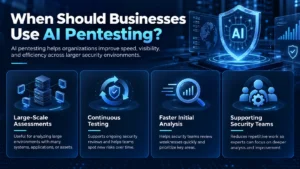
AI pentesting can be useful for organizations that need faster analysis, automated assistance, and improved security visibility across larger environments. It is especially valuable when businesses want to support their security teams with technologies that reduce repetitive testing tasks.
Large-Scale Vulnerability Assessments
AI-assisted testing can help organizations analyze larger systems and identify potential vulnerabilities more efficiently. This makes it useful for environments with many applications, systems, or assets.
Continuous Security Testing
AI capabilities can support ongoing security assessments by helping teams regularly analyze environments and identify changes that may introduce new risks.
Faster Initial Analysis
AI can help security teams quickly review potential weaknesses and prioritize areas that need further investigation.
Supporting Security Teams
AI tools can reduce manual workload and allow security professionals to focus on deeper analysis, validation, and strategic security improvements..
See More: Types of Penetration Testing: Key Methods & Approaches in Cybersecurity
When Businesses Should Use Traditional Penetration Testing?
Traditional penetration testing is more suitable when organizations require deeper security analysis, realistic attack simulations, and expert evaluation of complex systems. Human-led testing provides valuable insight into how vulnerabilities can affect real business operations.
Compliance Assessments
Organizations with regulatory or compliance requirements often require detailed testing processes and expert validation of security controls.
Complex Applications
Applications with complex workflows and business logic often require human analysis to identify vulnerabilities that automated tools may not detect.
Business-Critical Systems
Critical systems require careful testing to understand potential risks and minimize operational impact.
Realistic Attack Simulations
Traditional penetration testing helps organizations understand how skilled attackers may approach their environment through customized attack scenarios.
See More: What Is Black Box Penetration Testing? Steps & Tools
Can AI and Traditional Penetration Testing Work Together?
Yes, AI and traditional penetration testing can work together as part of a hybrid security testing approach. Instead of replacing human-led assessments, AI can support penetration testers by improving speed, reducing repetitive tasks, and helping analyze large amounts of security data.
In a hybrid approach, AI assists with activities such as vulnerability discovery, information analysis, and risk prioritization. Security professionals then use their expertise to validate findings, simulate realistic attacks, and determine how identified vulnerabilities could affect business operations. Combining both approaches allows organizations to benefit from the efficiency of AI while maintaining the depth, creativity, and decision-making capabilities of experienced penetration testers.
AI Supports Testing Efficiency
AI helps security teams handle repetitive and time-consuming activities such as analyzing security data, identifying patterns, and prioritizing potential vulnerabilities. This allows testers to spend more time on complex assessments that require human judgment and technical expertise.
Human Testers Validate Security Risks
Human penetration testers evaluate AI-generated findings to confirm accuracy and understand their real-world impact. They analyze attack paths, test complex vulnerabilities, and provide recommendations based on the organization’s specific environment and security objectives.
Combined Approach Improves Security Assessments
A hybrid model provides a balanced approach where AI improves testing speed while human expertise ensures accuracy and deeper analysis. This combination helps organizations identify vulnerabilities more effectively and make better-informed security decisions.
See More: What Is Gray Box Penetration Testing? Methods & Techniques
Protect Your Business With Effective Penetration Testing Strategies
AI-powered testing can help security teams improve vulnerability discovery and analyze security risks more efficiently. However, effective penetration testing still requires human expertise to validate findings, understand business impact, and identify complex security weaknesses. CyberZEALS helps organizations select the right penetration testing approach based on their security objectives, technology environment, and risk requirements.
Our experts combine modern security technologies with proven penetration testing methodologies to deliver assessments that provide meaningful security insights. Whether your organization needs AI-assisted testing, traditional penetration testing, or a combination of both approaches, CyberZEALS helps identify vulnerabilities and strengthen your security posture.
FAQs
Can AI Perform a Complete Penetration Test Without Human Involvement?
No. AI can automate tasks, but human expertise is needed for validation and analysis.
What Are The Limitations Of AI Penetration Testing?
AI may struggle with complex attacks, business logic issues, and contextual analysis.
How Do Security Teams Use AI During Penetration Testing?
Security teams use AI to automate tasks, analyze vulnerabilities, and prioritize risks.
Can AI Pentesting Replace Ethical Hackers?
No. AI supports ethical hackers but does not replace human expertise and decision-making.
What Factors Should Businesses Consider Before Choosing A Pentesting Approach?
Businesses should consider security goals, system complexity, compliance needs, and testing requirements.
How Does a Hybrid AI and Human Penetration Testing Approach Work?
AI automates tasks while security professionals validate findings and assess risk.
If you have any query, then call us on +1 888 533 0044 or contact us now and get in touch with us.