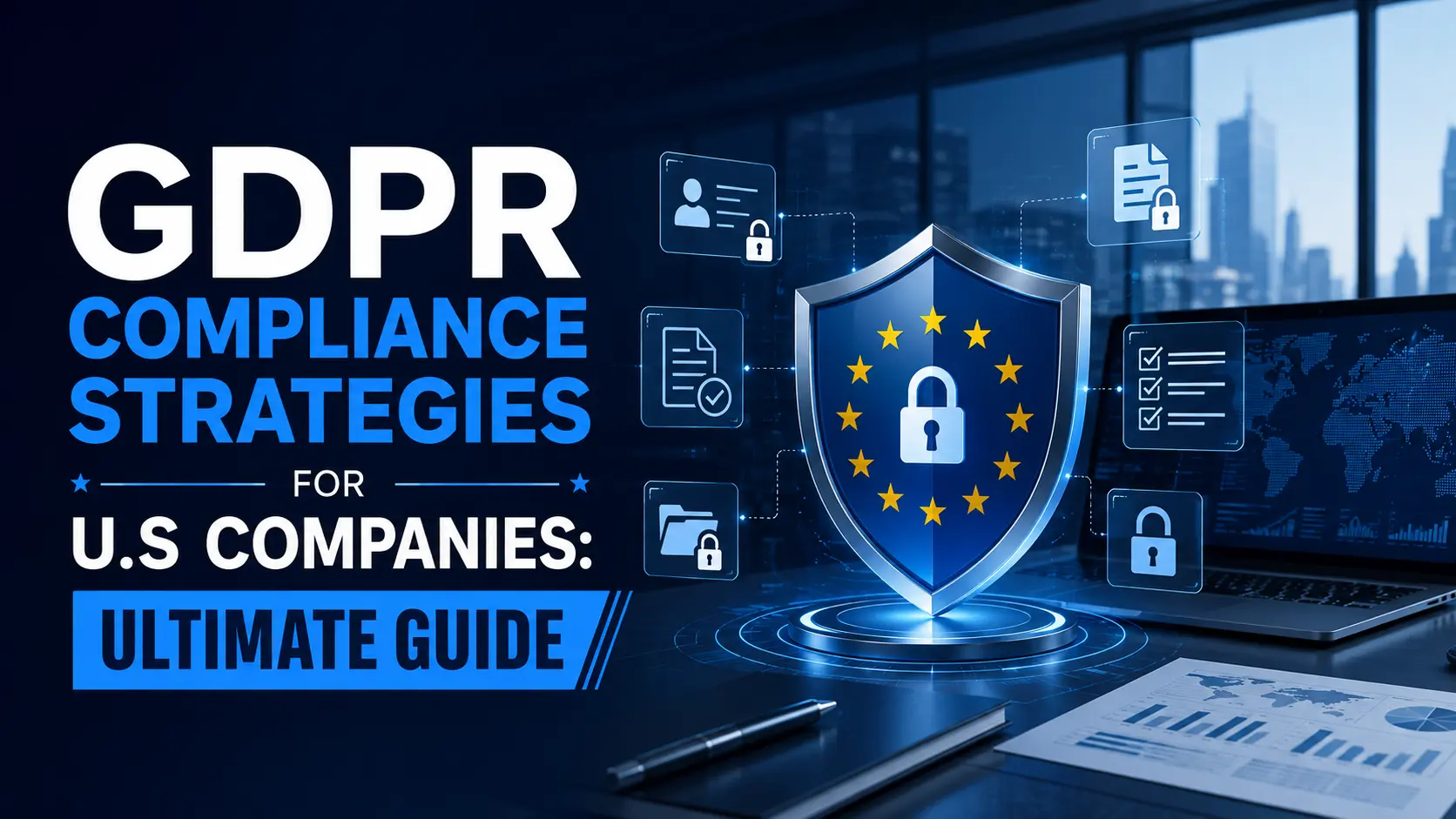
GDPR compliance strategies matter for U.S. companies that collect, use, or store personal data linked to people in the European Union. A business does not need a physical office in Europe to fall under GDPR. In some cases, offering products or services to people in the EU or monitoring their online behavior can bring a U.S. company within scope.
For many U.S. businesses, the real challenge is understanding what GDPR requires and turning those rules into practical steps. This guide explains how to manage personal data, reduce compliance gaps, strengthen security controls, and build a GDPR process that fits SaaS companies, small businesses, and other U.S. organizations.
Does GDPR Apply to U.S. Companies?
Yes, GDPR can apply to U.S. companies in specific situations. A U.S. business may fall under GDPR when it offers goods or services to people who are in the EU or monitors their behavior while they are there. For example, a U.S. SaaS provider that actively sells subscriptions to EU customers may need to assess whether its processing falls within GDPR scope.
Simply receiving a website visit from Europe does not automatically mean GDPR applies. Businesses assessing GDPR compliance in the U.S. should look at how they target EU users, what personal data they collect, why they process it, and whether they monitor behavior.
What Are the GDPR Requirements for U.S. Companies?
There is no separate version of GDPR requirements for U.S. companies. When GDPR applies, the relevant requirements of the regulation apply to the processing activity.
A U.S. company may need to address areas such as the following:
- A lawful basis for processing personal data.
- Clear privacy information.
- Data minimization and storage limits.
- Data subject rights.
- Processor and subprocessor controls.
- Security of personal data.
- Records of processing.
- Breach response.
- Cross-border data transfers.
- Data protection impact assessments where required.
GDPR also uses an accountability principle. Organizations need to comply with the rules and be able to show how they comply through policies, records, contracts, risk assessments, and other evidence.
What Are the Main GDPR Compliance Strategies?
Effective GDPR compliance strategies start with understanding how personal data moves through the business. Policies written without that information can easily miss applications, vendors, employees, or processing activities that actually create risk.
The following steps provide a practical structure for building and maintaining compliance.
Map Personal Data and Processing Activities
Create an inventory of the personal data the business collects, receives, stores, uses, shares, and deletes. For each processing activity, record what data is involved, why it is processed, who can access it, which systems hold it, which vendors receive it, how long it is kept, and whether it is transferred outside the European Economic Area.
The European Data Protection Board identifies these details as core information for records of processing activities. A useful data map should cover customer systems, CRM platforms, cloud applications, marketing tools, employee systems, support platforms, analytics services, backups, and third-party integrations.
Identify a Lawful Basis for Processing
Every processing activity covered by GDPR needs a valid lawful basis. Consent is one lawful basis, but it is not the only one. Article 6 also includes contract, legal obligation, vital interests, public task, and legitimate interests under defined conditions.
A company should document the lawful basis connected to each processing purpose. For example, processing information needed to provide a purchased SaaS subscription may rely on a different lawful basis from sending optional marketing communications.
Apply Data Minimization and Retention Rules
Collect only the personal data needed for a defined purpose. A form that needs a name and business email address should not request unrelated personal information without a valid reason. The same principle applies after collection: data should not be kept indefinitely simply because storage is available.
Businesses should define retention periods based on purpose, legal requirements, contracts, and operational needs. Retention rules should also cover copies stored in archives and other systems where practical.
Manage Consent Where It Is Required
When a business relies on consent, the consent needs to meet GDPR requirements. Consent should relate to a clear purpose and be given through a genuine choice. Businesses should also keep evidence of consent and provide a way for the individual to withdraw it.
Do not use consent automatically for every processing activity. First determine whether another lawful basis properly applies to the purpose.
Create a Process for Data Subject Requests
GDPR gives individuals rights over their personal data, including rights that can apply to access, correction, deletion, restriction, objection, and data portability depending on the circumstances. A business needs a defined process for receiving, verifying, tracking, and responding to requests. That process should identify which teams and systems may contain relevant information.
For SaaS companies, this can be difficult when the same person’s information exists across production systems, support platforms, analytics tools, backups, and subprocessors.
Review Third-Party Data Processors
Many businesses rely on cloud providers, CRM systems, payroll platforms, analytics tools, customer support software, and other vendors to process personal data. GDPR requires controller-processor relationships to be governed by appropriate contracts. Processor contracts address areas such as processing instructions, confidentiality, security, and the use of subprocessors.
Vendor reviews should therefore cover more than security questionnaires. Check what personal data the provider handles, where it is processed, which subprocessors are involved, how incidents are reported, and what happens to the data when the contract ends.
Maintain GDPR Compliance Documentation
GDPR compliance needs evidence. Useful documentation can include records of processing activities, privacy notices, data processing agreements, retention rules, security policies, risk assessments, breach procedures, data subject request records, transfer documentation, and DPIAs where required.
The EDPB notes that organizations need to process personal data in line with GDPR and be able to demonstrate that compliance.
GDPR Cybersecurity Requirements U.S. Companies Should Address
GDPR is a data protection law, not a cybersecurity framework. However, cybersecurity is an important part of GDPR compliance. Article 32 requires controllers and processors to use appropriate technical and organizational security measures based on risk.
The correct controls depend on factors such as the type of personal data, the processing environment, available technology, and the possible impact on individuals.
Access Control and Least Privilege
Personal data should be available only to people and systems that need it. Use individual accounts, appropriate authentication, role-based access, and regular permission reviews. Remove access when employees leave or change roles, and avoid giving administrator rights to users who do not need them.
The EDPB specifically recommends managing authorization according to need and regularly removing obsolete access permissions.
Encryption and Data Protection
Encryption can reduce the risk of unauthorized access to personal data. Depending on the risk, organizations may use encryption for stored data and information moving between systems. Pseudonymization can also reduce exposure by separating identifying information from other data.
Encryption alone does not create GDPR compliance. It should form part of a wider set of controls around access, systems, people, and processes.
Endpoint Security and Monitoring
GDPR endpoint compliance is not a separate certification requirement. The relevant issue is whether devices that handle personal data have security controls appropriate to the risk.
Measures may include endpoint protection, software updates, device authentication, session locking, malware protection, restricted administrator rights, and monitoring. Personal devices used for business data also need appropriate controls when the organization permits their use.
Backup and Recovery
Organizations should plan for loss of access to personal data caused by system failure, ransomware, accidental deletion, or other incidents.
Backups should match the importance of the data and the recovery needs of the organization. The EDPB includes backup and retrieval policies among practical security measures businesses should consider. Backups also need access controls, retention rules, and testing. A backup that cannot be restored does not provide useful recovery capability.
Breach Detection and Incident Response
Businesses need a process for identifying and assessing personal data breaches. Under Article 33, a controller must notify the competent supervisory authority without undue delay and, where feasible, within 72 hours after becoming aware of a personal data breach when the breach meets the notification threshold. Notification is not required under that article when the breach is unlikely to create a risk to individuals’ rights and freedoms.
Incident response procedures should identify who investigates an incident, who assesses privacy impact, who makes notification decisions, and how the organization keeps records of what happened.
Best GDPR Compliance Strategies for SaaS Companies
The best strategies for GDPR compliance in SaaS companies focus heavily on data visibility because SaaS products often rely on cloud infrastructure, integrations, analytics platforms, support systems, and multiple subprocessors.
A SaaS company should know where customer data goes from account creation through deletion.
Know Where Customer Data Is Stored
Document where customer and user information is stored, including production databases, authentication systems, logs, analytics platforms, support tools, backups, file storage, development environments, and other systems that may contain personal data.
Review Subprocessors and Cloud Vendors
SaaS providers often depend on hosting providers, email services, analytics platforms, payment processors, customer support tools, and infrastructure vendors. Maintain a current list of subprocessors and understand what each one does with personal data.
Review contracts, processing locations, security responsibilities, and transfer mechanisms. Vendor changes should trigger a review when they affect personal data processing.
Build Privacy Into Product Development
Privacy requirements should be considered when new features are designed. Before collecting a new type of personal data, determine why the product needs it, how long it will be kept, who will have access, and whether the user needs additional information or controls.
The EDPB describes data protection by design and by default as building data protection into processing activities and ensuring that only data necessary for the specific purpose is processed by default.
Manage User Data Requests Across SaaS Systems
Data subject requests can involve several connected platforms. Define how support, legal, security, engineering, and privacy teams handle a request. Determine how personal information will be found across applications and how actions such as correction or deletion will be passed to relevant systems and processors.
Control International Data Transfers
A U.S. SaaS company receiving personal data from the EU needs to understand the transfer mechanism that applies. The European Commission currently recognizes U.S. commercial organizations participating in the EU-U.S. Data Privacy Framework as providing adequate protection for covered transfers. Other mechanisms, including Standard Contractual Clauses and Binding Corporate Rules, may be relevant in other situations.
GDPR Compliance for Small Businesses
GDPR compliance for small businesses should start with the processing that creates the greatest privacy and security risk. A smaller organization may have fewer systems and vendors, but business size does not create a general exemption from GDPR when the regulation applies.
Start With High-Risk Data Processing
Identify which activities involve sensitive information, large amounts of personal data, monitoring, important customer systems, or access by several outside providers. Address the most serious gaps first. Examples may include weak account security, unknown data storage locations, unnecessary data collection, or vendors operating without suitable agreements.
Keep Documentation Practical
Documentation does not need to be unnecessarily complicated. A small company can maintain a clear processing register that records the activity, purpose, data categories, recipients, retention period, transfers, and relevant security controls. The documentation needs to reflect what the business actually does.
Review Vendors and Cloud Applications
Small businesses often depend heavily on third-party software. Review CRM systems, email marketing tools, payment providers, cloud storage, HR platforms, analytics software, and customer support services. Confirm what personal data each service receives and why.
Assign Clear Compliance Responsibility
Someone inside the business should own the compliance process. That does not automatically mean every small company needs a data protection officer. The GDPR requires a DPO in defined situations, including certain large-scale monitoring and large-scale processing of special-category or criminal-offence data.
GDPR Compliance Responsibilities for Legal Advisors in the U.S.
GDPR compliance responsibilities for legal advisors in the U.S. depend on the organization and the advisor’s role. Legal and privacy advisors commonly help determine whether GDPR applies, review lawful bases, assess privacy notices, review processor agreements, evaluate international transfer arrangements, interpret data subject rights, and advise on breach notification obligations.
Cybersecurity teams have a different role. They assess technical controls, access security, monitoring, vulnerabilities, incident response, and other measures used to protect personal data. Legal, privacy, compliance, and security teams should coordinate because GDPR obligations often cross these areas.
What Are the Main Challenges of Data Protection Under GDPR?
The main challenges of data protection are often operational. A company may understand the rule but still struggle to apply it consistently across several systems, vendors, and teams.
Finding Personal Data Across Multiple Systems
Personal information can exist in CRM platforms, SaaS applications, email systems, shared drives, cloud databases, employee devices, backups, and vendor platforms. If the company cannot locate the information, it becomes harder to apply retention rules, investigate incidents, or respond to data subject requests.
Managing Third-Party Processors
Vendor environments change. Providers add subprocessors, change infrastructure, introduce new products, and update processing locations. Companies need a process for keeping vendor information and contracts current.
Handling Data Subject Requests
Requests can involve several internal teams and systems. Problems often appear when ownership is unclear, identities cannot be verified consistently, or information is difficult to locate. A documented workflow reduces those issues.
Controlling Data Retention
Keeping data forever is easier than deleting it correctly. Retention becomes difficult when the same personal information exists in production platforms, archives, exported spreadsheets, support systems, and backups.
Managing Cross-Border Data Transfers
International transfers require ongoing attention because organizations may use several cloud and SaaS providers across multiple countries. Record where covered personal data goes and which transfer mechanism supports each relevant transfer.
Keeping Security and Privacy Controls Current
Systems, risks, staff, vendors, and processing activities change. Access reviews, vulnerability management, incident procedures, privacy documentation, and risk assessments need to change with the environment.
How to Assess GDPR Compliance in the U.S.
Assessing GDPR compliance in the U.S. should begin with evidence about the company’s real processing activities. A useful assessment checks legal, operational, vendor, and security controls instead of relying only on a policy checklist.
Review Your Data Inventory
Check whether the company knows what personal data it processes, where the data comes from, which systems store it, who receives it, and how long it is retained. Compare the inventory with the actual applications and vendors in use.
Check Processing Purposes and Legal Bases
Each processing activity should have a defined purpose. Check whether the recorded lawful basis matches that purpose and whether the business is processing data beyond what is needed.
Review Security Controls
Review authentication, permissions, endpoint security, encryption, logging, vulnerability management, backups, incident response, and other controls relevant to personal data. GDPR security measures should be appropriate to the risk, so the assessment should consider the type of data and possible impact on individuals.
Check Vendor Agreements
Confirm that processors handling personal data have appropriate agreements in place. Check subprocessor arrangements, processing locations, incident requirements, deletion terms, and relevant international transfer mechanisms.
Test Data Subject Request Procedures
Do not rely only on a written procedure. Run a test request and confirm whether the company can locate data, verify the individual, coordinate with vendors, document actions, and complete the workflow.
Review Compliance Records
Check whether the company can show evidence of its decisions and controls. Records may include processing activities, vendor reviews, risk assessments, security reviews, incidents, data subject requests, training, retention decisions, and transfer documentation.
Can Businesses Self-Manage GDPR Compliance?
Yes, some businesses can manage significant parts of GDPR compliance internally. This is more practical when the organization has a simple processing environment, clear ownership, suitable privacy and security skills, and limited high-risk processing.
External support may be useful when the business has complex international transfers, sensitive data, large-scale monitoring, unclear legal obligations, major security gaps, or an incident that may require regulatory notification.
Legal questions should be reviewed by qualified legal or privacy professionals. Technical GDPR cybersecurity compliance can be assessed separately by cybersecurity teams.
Common GDPR Compliance Mistakes U.S. Companies Should Avoid
Assuming GDPR Does Not Apply Outside Europe
A company’s U.S. location does not by itself remove GDPR obligations. Article 3 can extend the regulation to processing by organizations outside the EU when the relevant conditions are met.
Treating Consent as the Only Lawful Basis
Consent is one lawful basis. GDPR Article 6 lists several lawful bases, and the correct choice depends on the processing purpose and circumstances.
Keeping Personal Data Too Long
Personal data should have a defined retention purpose and period. Keeping information indefinitely can conflict with GDPR storage-limitation principles and makes a security incident potentially affect more data.
Ignoring Third-Party Processors
Sending personal information to a vendor does not remove the organization’s GDPR responsibilities. Companies need to understand their controller and processor relationships and maintain appropriate contractual controls.
Weak Security Documentation
A business may have good security tools but poor evidence of how personal data is protected. Document relevant controls, access reviews, risk decisions, incident procedures, vulnerability management, and remediation work.
Treating GDPR Compliance as a One-Time Project
A compliance assessment shows the position at a point in time. New products, vendors, employees, processing activities, security threats, and transfers can change the compliance position. Review controls when material changes occur and at suitable intervals.
GDPR Compliance Checklist for U.S. Companies
Use this GDPR compliance checklist as a starting point:
- Confirm whether GDPR applies to your processing activities.
- Create and maintain a personal data inventory.
- Document processing purposes and lawful bases.
- Review privacy notices.
- Apply data minimization and retention rules.
- Establish a data subject request process.
- Review processors and subprocessor arrangements.
- Maintain appropriate data processing agreements.
- Review international data transfers.
- Apply risk-based security controls.
- Review user and administrator access.
- Protect endpoints that process personal data.
- Maintain backups and recovery procedures.
- Document breach detection and response.
- Maintain relevant GDPR compliance records.
- Conduct DPIAs where processing is likely to create high risk.
- Reassess compliance when systems, vendors, or processing activities change.
How CyberZeals Can Support GDPR Cybersecurity Compliance
CyberZeals can support the technical and cybersecurity parts of a GDPR compliance program. Depending on the environment, this work may include cybersecurity assessments, access control reviews, vulnerability assessments, penetration testing, cloud security reviews, endpoint security assessments, incident response planning, and remediation support.
The purpose of this work is to identify technical security gaps that affect personal data and document practical steps for addressing them.
Legal interpretation, lawful-basis decisions, regulatory representation, and other legal GDPR matters should be handled with appropriate legal or privacy counsel.
Frequently Asked Questions
Does GDPR Apply to U.S. Companies Without an EU Office?
Yes. A U.S. company can fall within GDPR scope when relevant processing relates to offering goods or services to people in the EU or monitoring their behavior there.
What Are the Main GDPR Requirements for U.S. Companies?
When GDPR applies, key areas can include lawful processing, transparency, individual rights, data minimization, processor controls, security, documentation, breach response, and international transfers.
Does a Small U.S. Business Need to Comply With GDPR?
Possibly. Small size does not create a general GDPR exemption; applicability depends mainly on the processing activity and the GDPR’s territorial scope.
Can a Business Manage GDPR Compliance Internally?
Yes, when it has suitable legal, privacy, operational, and security knowledge, although complex or high-risk situations may require outside professional support.
What Cybersecurity Controls Support GDPR Compliance?
Depending on risk, useful controls can include access management, authentication, endpoint protection, encryption, logging, vulnerability management, backups, monitoring, and incident response.
How Often Should a Company Assess GDPR Compliance?
GDPR does not set one universal annual assessment schedule for every business; companies should review compliance when processing or risk changes and at intervals suitable for their environment.
What Happens if a U.S. Company Does Not Comply With GDPR?
A U.S. company that falls within GDPR scope can face regulatory action. For certain infringements, Article 83 allows administrative fines of up to €20 million or 4% of total worldwide annual turnover from the preceding financial year, whichever is higher, with the actual enforcement response depending on the circumstances.