Artificial intelligence is changing how businesses manage technology, analyze information, and make decisions. From identifying IT problems before they affect customers to developing intelligent applications that continuously improve, AI is becoming an important part of modern business operations. But as organizations adopt AI, two terms are appearing more frequently: AIOps and MLOps.
Although they sound similar, they solve different problems. One helps IT teams manage increasingly complex technology environments, while the other helps organizations develop, deploy, and maintain machine learning models efficiently. Understanding what AIOps and MLOps are is essential for businesses looking to improve operational performance, reduce manual work, and build scalable technology infrastructure.
Let’s break down both concepts, explore their differences, and understand how businesses can use them together to achieve better results.

What Is AIOps?
AIOps stands for Artificial Intelligence for IT Operations. In simple terms, it uses artificial intelligence, machine learning, automation, and advanced data analytics to help IT teams monitor, manage, and troubleshoot technology environments. Instead of depending entirely on engineers to identify problems manually, AIOps analyzes large amounts of operational data and helps detect potential issues automatically.
Think about a business running multiple applications, cloud platforms, servers, and network systems. Monitoring everything manually can quickly become challenging. An issue in one application might affect several connected services, making it difficult to identify the actual cause. AIOps brings these signals together, identifies unusual behavior, connects related events, and helps IT teams understand what is happening before a small issue becomes a major disruption.
How Does AIOps Work?
AIOps works by collecting operational data from different IT sources, including application logs, system metrics, network activity, infrastructure monitoring tools, and performance records. Machine learning algorithms analyze this information to recognize patterns, detect unusual activities, and identify potential service disruptions.
For example, imagine an e-commerce website experiencing slower response times during peak shopping hours. Traditional monitoring might generate multiple alerts about server performance, database activity, and application errors. AIOps can correlate these alerts, identify their possible relationship, and help engineers locate the underlying problem. This makes troubleshooting faster and reduces the time IT teams spend investigating unrelated alerts.
What Is MLOps?
MLOps stands for Machine Learning Operations. It refers to the practices, processes, and technologies used to develop, deploy, monitor, and maintain machine learning models throughout their lifecycle. Its primary purpose is to bring machine learning development and IT operations together so businesses can move AI models from experimentation into reliable production environments.
Developing a machine learning model is only one part of the process. The real challenge begins when an organization needs to deploy that model, manage different versions, monitor its accuracy, handle new data, and maintain consistent performance. MLOps provides a structured approach to managing these activities. It helps data scientists, machine learning engineers, and IT teams work better together while making machine learning systems easier to manage, scale, and maintain.
How Does MLOps Work?
MLOps creates a repeatable workflow for managing machine learning models. It typically includes data preparation, model development, testing, version control, deployment, performance monitoring, and model retraining. Automation plays an important role because it reduces repetitive tasks and makes the entire machine learning lifecycle more manageable.
For example, consider a financial company using machine learning to identify potentially fraudulent transactions. As customer behavior and transaction patterns change, the model may need updated training data and regular performance checks. With MLOps, the organization can automate model testing, track performance, manage deployment versions, and establish retraining workflows. This helps ensure that the model remains useful and reliable as business conditions evolve.
AIOps vs. MLOps: What Is the Difference?
One of the most common questions businesses ask is whether AIOps and MLOps are the same thing. The short answer is no. Both use artificial intelligence and machine learning, but their objectives are different.
AIOps focuses on improving IT operations through intelligent monitoring, anomaly detection, event correlation, and automated incident management. MLOps focuses on managing machine learning models, from development and experimentation to deployment and ongoing maintenance. In other words, AIOps helps organizations operate their technology environments more intelligently, while MLOps helps them operate their machine learning systems more efficiently.
Here is a quick comparison:
Comparison | AIOps | MLOps |
Full Form | Artificial Intelligence for IT Operations | Machine Learning Operations |
Main Purpose | Improve IT operations. | Manage ML model lifecycles. |
Primary Focus | Monitoring and troubleshooting | Model development and deployment |
| Main Users | IT operations and DevOps teams | Data scientists and ML engineers |
| Key Technologies | AI, ML, analytics, automation | ML pipelines, CI/CD, automation |
| Main Benefits | Faster incident detection and resolution | Reliable and scalable ML deployment |
Understanding these differences helps organizations choose the right approach based on their technical requirements and business objectives.
What Are Common Use Cases for AIOps and MLOps?
AIOps and MLOps support different areas of business technology, but both contribute to better efficiency, reliability, and scalability. Their applications extend across industries, including banking, healthcare, retail, telecommunications, manufacturing, and technology services.
Let’s explore some practical use cases where these technologies deliver measurable value.
Common AIOps Use Cases
1. Intelligent IT Monitoring
AIOps continuously analyzes infrastructure and application performance to identify unusual behavior. It helps teams detect potential problems earlier instead of waiting for users to report service disruptions.
2. Automated Incident Management
IT teams often receive hundreds or thousands of alerts from different monitoring systems. AIOps can connect related alerts, prioritize important incidents, and support automated responses to recurring problems.
3. Root Cause Analysis
When an application or service stops working correctly, identifying the actual cause can take considerable time. AIOps analyzes related operational events and performance data to help engineers locate the source of an issue.
4. Predictive Infrastructure Management
AIOps can identify patterns that indicate possible infrastructure failures, performance degradation, or capacity limitations. This allows businesses to take preventive action before problems affect critical services.
5. Cloud Performance Optimization
Organizations operating across multiple cloud environments can use AIOps to monitor resource utilization, identify performance issues, and improve infrastructure efficiency.
Common MLOps Use Cases
1. Automated Machine Learning Deployment
MLOps helps organizations move machine learning models from development environments into production through standardized and automated deployment workflows.
2. Fraud Detection Systems
Banks and financial institutions use machine learning models to identify suspicious transactions. MLOps helps manage model versions, monitor prediction quality, and support regular updates.
3. Predictive Analytics
Businesses use predictive models to forecast demand, understand customer behavior, and identify emerging trends. MLOps helps maintain these models as new data becomes available.
4. Recommendation Engines
E-commerce platforms and digital services use machine learning to recommend products, services, and content. MLOps supports the continuous deployment and monitoring of these recommendation models.
5. Model Monitoring and Retraining
Machine learning models can become less accurate when real-world data changes. MLOps helps organizations monitor model performance, identify data or model drift, and manage retraining workflows when necessary.
What Are the Benefits of AIOps and MLOps for Businesses?
Adopting AIOps and MLOps is not simply about introducing more advanced technology. It is about solving practical business challenges, improving productivity, and making technology operations more predictable.
AIOps helps reduce the operational burden on IT teams by automating repetitive monitoring and investigation activities. MLOps makes machine learning workflows more consistent and manageable. Together, they can help businesses improve service reliability, accelerate innovation, reduce manual intervention, and build technology environments that support long-term growth.
Some important benefits include:
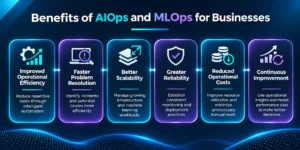
- Improved operational efficiency: Reduce repetitive tasks through intelligent automation.
- Faster problem Resolution: Identify incidents and potential causes more efficiently.
- Better scalability: Manage growing infrastructure and machine learning workloads.
- Greater reliability: Establish consistent monitoring and deployment practices.
- Reduced operational costs: Improve resource utilization and minimize unnecessary manual work.
- Continuous improvement: Use operational insights and model performance data to make better decisions.
The biggest advantage is that businesses can spend less time managing operational complexity and more time improving their products, services, and customer experiences.
Can AIOps and MLOps Work Together?
Absolutely. Although AIOps and MLOps serve different purposes, they can complement each other within a modern technology ecosystem. MLOps provides the infrastructure and processes needed to build and maintain machine learning models, while AIOps helps monitor and optimize the IT environments where these models and applications operate.
For example, a company running machine learning applications in the cloud can use MLOps to manage model deployment, versioning, and retraining. At the same time, AIOps can monitor the infrastructure supporting those applications, identify unusual resource consumption, detect service disruptions, and help maintain system availability. This creates a more connected approach to managing intelligent technology environments.
Deploy Scalable AIOps and MLOps with CyberZEALS
Adopting AIOps and MLOps successfully requires more than choosing AI tools. Businesses need reliable infrastructure, secure cloud environments, automation, monitoring, data pipelines, and operational processes that can support AI workloads at scale.
CyberZEALS helps businesses build that foundation through IT Consulting Services, Cloud Support Services, Cloud Infrastructure Management,, Cybersecurity Services, DevSecOps, and CI/CD Pipeline Security. These services support the core infrastructure, security, monitoring, and deployment requirements behind practical AIOps and MLOps environments.
Whether your goal is to improve IT monitoring, automate operational workflows, support machine learning pipelines, strengthen cloud infrastructure, or secure AI-driven systems, CyberZEALS can help assess your current environment and identify the technical improvements needed before implementation.
Our focus is on building scalable, secure, and manageable technology environments where automation and AI can deliver measurable operational value rather than adding unnecessary complexity.
Final Thoughts: Which Is Right for Your Business?
So, what is AIOps and MLOps, and which one should your business adopt? The answer depends on the challenges you want to solve. If your priority is improving IT monitoring, reducing alert fatigue, detecting incidents, and optimizing infrastructure performance, AIOps is a strong approach. If you want to manage machine learning models, automate deployment, monitor model accuracy, and scale AI applications, MLOps is essential.
For businesses looking to build a mature AI-driven technology environment, combining both approaches can deliver even greater value. AIOps makes IT operations smarter, while MLOps makes machine learning systems more manageable and reliable. With the right strategy and implementation partner, businesses can move beyond experimentation and build technology capabilities that deliver lasting results.
Frequently Asked Questions (FAQs)
1. What is AIOps and MLOps?
AIOps uses AI to optimize IT operations, while MLOps manages machine learning model development and deployment.
2. What is the main difference between AIOps and MLOps?
AIOps focuses on IT monitoring and operational efficiency, whereas MLOps manages the machine learning lifecycle.
3. What are the common use cases for AIOps and MLOps?
AIOps supports intelligent monitoring and incident management, while MLOps enables fraud detection and predictive analytics.
4. Can AIOps and MLOps work together?
Yes, both complement each other by improving IT infrastructure management and streamlining machine learning workflows.
5. How can CyberZEALS help businesses deploy scalable AIOps and MLOps?
CyberZEALS helps businesses implement intelligent automation, optimize IT operations, and scale technology efficiently.