
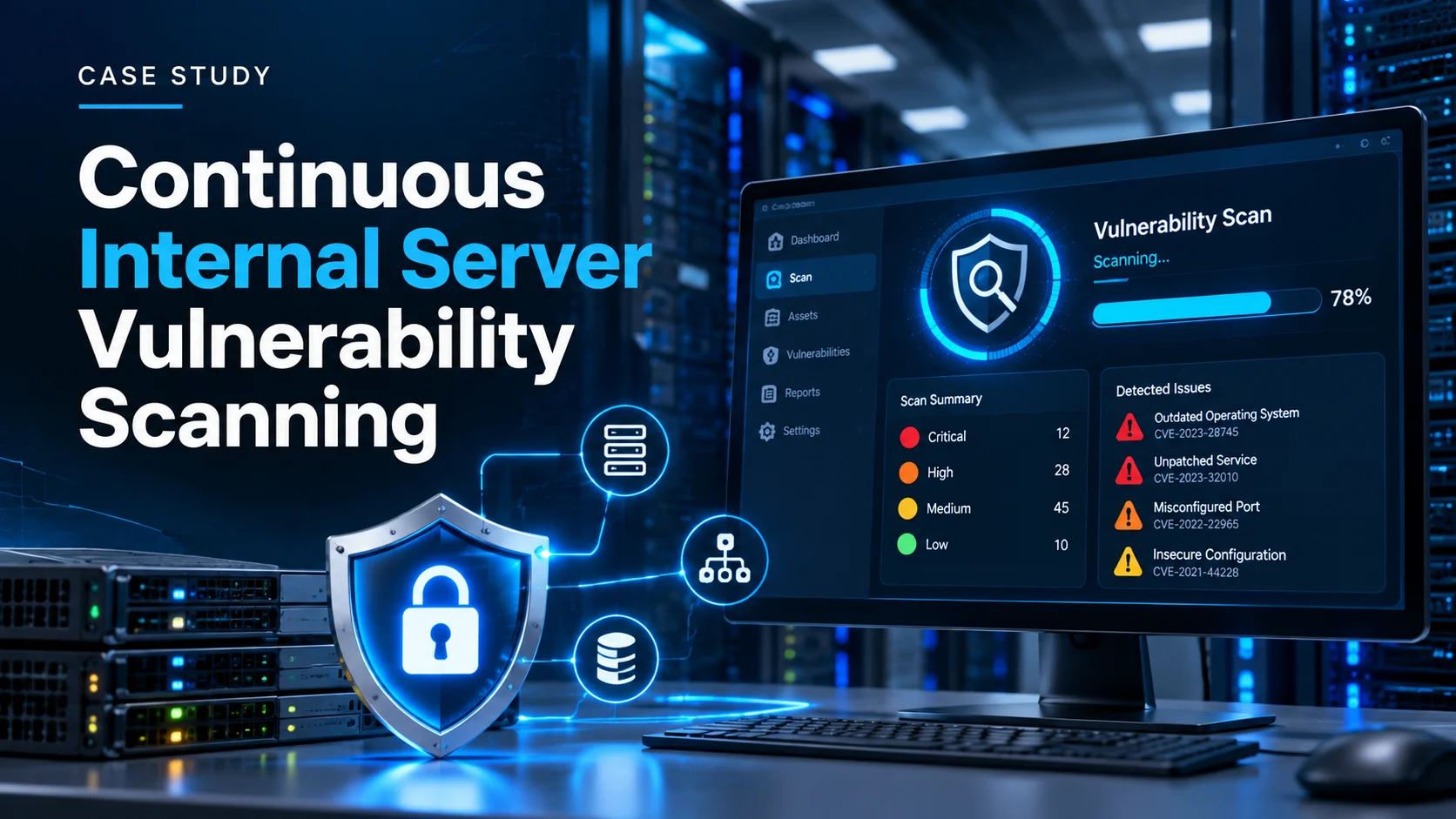
How CyberZEALS used Nessus Advanced Scan to assess approved corporate, infrastructure, and lab subnets, map reachable services, identify outdated operating systems and software, correlate exposures to CVEs, and support continuous remediation across the internal environment.
SUBNET COVERAGE | FULL PORT DISCOVERY | AUTHENTICATED AUDITING | CVE CORRELATION | PCI DSS SUPPORT
Client confidentiality
The client name, internal addresses, hostnames, credentials, and exact findings are withheld. This public case study describes the engagement methodology, representative finding classes, and business outcomes without exposing sensitive infrastructure details. Pasted text
01 Engagement Snapshot
What we assessed and how the program was designed
| Field | Detail |
| Client | Confidential organization with multiple internal server environments |
| Environment | Corporate, infrastructure, and lab networks |
| Targets | Approved IPv4 subnets containing Windows, Linux, virtual hosts, and supporting services |
| Assessment | Internal vulnerability assessment with recurring scans and remediation verification |
| Platform | Tenable Nessus Advanced Scan and Advanced Dynamic Scan capabilities |
| Coverage | Host discovery, authorized all-port scanning, service and version detection, authenticated patch and configuration auditing, CVE and plugin correlation |
| Compliance support | Targeted PCI DSS and secure-configuration evidence, where applicable |
| Cadence | Scheduled continuous scanning plus focused scans after major changes or urgent CVE disclosures |
02 Why Continuous Internal Scanning Matters
Internal risk changes whenever systems, services, patches, and network paths change
The client operated multiple server groups across corporate, infrastructure, and lab networks. A one-time assessment could identify a snapshot of exposure, but it could not reliably show whether new hosts, newly opened services, outdated components, or recently disclosed vulnerabilities appeared after the initial scan. CyberZEALS designed a repeatable scanning program that provided both broad subnet visibility and deeper authenticated evidence.
- Multiple IP subnets made it difficult to maintain a current inventory of live hosts and exposed services.
- Legacy operating systems, hypervisors, and server software increased the likelihood of unsupported or unpatched components.
- Open administrative and application ports needed to be reviewed against business need and network segmentation policy.
- PCI DSS and internal hardening requirements required evidence beyond simple banner-based vulnerability detection.
- Remediation teams needed prioritized, repeatable results that could be verified through follow-up scans. Pasted text
03 Our Assessment Approach
Layered scanning connected network exposure to host-level patch and configuration evidence
1 Subnet discovery and asset mapping
We scanned the approved corporate, infrastructure, and lab address ranges to identify responsive hosts and build a current asset baseline. Where authorized, the policy evaluated the full TCP port range to identify reachable services that could be missed by a common-port-only scan.
2 Port service and technology identification
For each reachable host, Nessus enumerated open ports and attempted to identify the service, protocol, encryption state, product family, and version information. Closed, filtered, and unresponsive states were treated carefully because firewalls and host controls can affect what a scanner can prove.
3 Vulnerability and CVE correlation
Nessus plugins evaluated detected operating systems, installed packages, server technologies, and exposed services against known vulnerability checks. Findings were correlated to applicable CVEs, severity, exploit context, vendor guidance, and remediation information when those data points were available.
4 Authenticated Windows and Unix auditing
Approved administrative credentials enabled deeper inspection over Windows and SSH-based channels. This provided stronger visibility into installed patches, package versions, registry and configuration settings, local services, and file-based evidence than an unauthenticated network scan alone.
5 Remediation validation and continuous coverage
Findings were assigned to system owners, prioritized by risk and asset importance, and rescanned after remediation. Recurring scans helped identify regressions, new systems, newly exposed services, and vulnerabilities introduced by later changes. Pasted text
04 Advanced Nessus Engineering
Custom policies reduced noise while preserving the depth required for enterprise networks
| Advanced capability | How CyberZEALS applies it |
| Full port discovery | Where approved, scan TCP ports 1 through 65535 and use credential-assisted enumeration when available. This improves visibility into services running on nonstandard ports. |
| File path exclusions | Exclude approved high-I/O database, backup, or sensitive application directories from deep Windows unmanaged-software searches or Unix find operations when the performance impact outweighs the value. Every exclusion is documented so it does not silently create a blind spot. |
| Compliance tuning | Select only the PCI DSS, CIS, or other audit content relevant to the target. Adjust network timeouts, compliance output limits, and audit scope carefully to reduce incomplete checks without creating excessive scan duration. |
| Dynamic plugin filtering | Use Advanced Dynamic Scan rules to select plugins by attributes such as severity, family, publication or modification date, and exploitability. A focused emergency policy can target newly released, critical, remotely exploitable checks while automatically including future plugins that match the rules. |
| Deep authenticated auditing | Use authorized Windows, SSH, database, network-device, or supported secrets-management credentials to inspect host-level configuration and patch evidence. Authentication success and credentialed-check coverage are validated rather than assumed. |
| Safe performance controls | Tune simultaneous hosts, checks per host, TCP sessions, safe checks, and stop-on-unresponsive behavior according to network capacity and asset sensitivity. Fragile legacy systems receive slower, conservative policies. |
| Debugging and audit trails | Enable plugin debugging and targeted packet capture when needed to investigate failed authentication, hanging checks, unexpected timeouts, or inconsistent results. Debug data is protected because it may contain sensitive network details. |
Accuracy note
Nessus does not guarantee discovery of every device, port, product version, or CVE. Firewalls, authentication quality, service banners, plugin coverage, scan windows, and target stability all affect results. CyberZEALS documents these limits and validates important findings before reporting them as confirmed risk. Pasted text
05 How the Program Operated
A controlled cycle from authorization through verified remediation
Phase 1 Scope and authorization
Confirm subnet ranges, owners, maintenance windows, excluded assets, production safety requirements, and escalation contacts.
Phase 2 Discovery baseline
Identify responsive hosts, compare results with the known asset inventory, and review unknown or unexpected systems.
Phase 3 Network exposure mapping
Enumerate reachable ports, protocols, services, product clues, TLS configuration, and host operating-system evidence.
Phase 4 Authenticated vulnerability audit
Inspect local software, patches, packages, configurations, and compliance controls using approved least-privilege or administrative credentials as required.
Phase 5 Analyst validation
Remove obvious false positives, confirm authentication quality, review plugin output, and group duplicate symptoms into actionable remediation items.
Phase 6 Risk-based reporting
Prioritize by technical severity, exploitability, asset criticality, exposure path, and business impact rather than CVSS alone.
Phase 7 Remediation and retest
Coordinate with infrastructure owners, verify patches or configuration changes, and retain evidence of closure or documented risk acceptance. Pasted text
06 Representative Finding Categories
The assessment converted raw scanner output into infrastructure decisions
| Finding class | What it revealed | Recommended response |
| Unnecessary exposed ports | Services reachable beyond their intended administrative or application boundary | Close the port, restrict source networks, or document the business requirement |
| Outdated server components | Unsupported operating systems, hypervisors, web servers, databases, and middleware | Upgrade, isolate, apply compensating controls, or create a replacement plan |
| Missing security updates | Host-level patch evidence linked to applicable CVEs and vendor updates | Prioritize by exploitability, asset criticality, and exposure path |
| Weak service configuration | Deprecated TLS, insecure protocols, weak ciphers, or unnecessary remote administration | Apply hardened baselines and verify through rescanning |
| Compliance gaps | Configuration evidence that did not meet selected PCI DSS or secure-build expectations | Assign control owners, remediate, and preserve audit evidence |
| Scan coverage gaps | Authentication failures, incomplete checks, or unstable targets that reduced confidence | Fix credentials, permissions, routing, or scan windows before accepting the result |
How findings were prioritized
CyberZEALS did not prioritize issues by scanner severity alone. Each finding was reviewed against the affected system’s business role, the exposure path, exploit maturity, data sensitivity, patch availability, and the strength of any compensating controls. This kept remediation focused on the weaknesses most likely to create material risk.
- Externally reachable or broadly accessible internal services received greater urgency than tightly segmented services.
- Known exploitation, remote code execution, privilege escalation, and authentication bypass increased priority.
- Domain services, virtualization hosts, databases, and business-critical application servers were evaluated in the context of their blast radius.
- Findings with incomplete authentication or uncertain version evidence were separated for validation instead of being reported as confirmed facts. Pasted text
07 Enterprise Use Cases
The same Advanced Scan controls support different operational priorities
| What companies need | How the Advanced Scan is used | Business value |
| Protect fragile legacy infrastructure | Reduce simultaneous host checks, enable safe checks, limit aggressive service probing, and stop when systems become unresponsive. | Assess mission-critical legacy systems with less operational risk. |
| Validate regulatory compliance | Use targeted audit files and configuration checks aligned to PCI DSS, CIS Benchmarks, DISA STIGs, or other applicable standards. | Generate repeatable evidence of hardening gaps and remediation. |
| Perform emergency CVE audits | Create a focused policy using relevant CVE plugin IDs or dynamic filters for newly published critical and exploitable checks. | Answer quickly whether a new vulnerability affects the authorized environment. |
| Optimize cloud and DevOps scanning | Restrict checks to relevant modern platforms, containers, cloud services, and supported operating systems when broad legacy coverage is unnecessary. | Reduce noise and fit vulnerability checks into faster change cycles. |
| Simulate an internal attack surface | Run an authorized unauthenticated assessment with broad port coverage to observe what a compromised internal user or unmanaged device could discover. | Validate segmentation and identify services exposed without trusted host access. |
| Verify patch campaigns | Repeat authenticated scans after operating-system and application patch windows, then compare remaining findings and coverage quality. | Give infrastructure teams evidence that high-risk vulnerabilities were closed. |
08 Business Outcomes
Continuous scanning created an operational vulnerability-management baseline
- Improved visibility across corporate, infrastructure, and lab server subnets.
- A defensible inventory of reachable ports, detected services, technologies, and version evidence.
- Clear identification of outdated operating systems, server products, host platforms, missing patches, and associated CVEs.
- Reduced noise through environment-specific plugin selection, exclusions, performance tuning, and analyst validation.
- Faster remediation by translating plugin output into prioritized actions for system owners.
- Stronger PCI DSS and internal hardening readiness through authenticated evidence and repeatable retesting.
- A continuous process that detects new exposure after infrastructure changes instead of relying on a single annual snapshot. Pasted text
09 What Nessus Does Best
Why it remains a core platform for internal vulnerability assessment
- Broad plugin coverage for operating systems, network services, applications, databases, virtualization platforms, and common enterprise technologies.
- Flexible discovery and port-scanning controls, including common-port and full-port assessment options.
- Credentialed checks that improve accuracy for patch, package, registry, service, and configuration findings.
- CVE, CVSS, plugin output, exploit context, and remediation guidance that help analysts prioritize technical risk.
- Custom policies, dynamic plugin rules, performance tuning, exclusions, and safe-check controls for complex networks.
- Compliance auditing with targeted audit content and support for repeatable remediation verification.
- Detailed troubleshooting through scan logs, plugin debugging, and controlled packet capture when deeper analysis is required. Pasted text
10 Capabilities Demonstrated
What this engagement shows CyberZEALS can deliver end to end
- Authorized internal vulnerability scanning across multiple network segments and server classes.
- Full-port exposure mapping and technology fingerprinting tailored to the approved scope.
- Authenticated Windows and Unix auditing for high-confidence patch and configuration evidence.
- Advanced Nessus policy engineering for legacy systems, modern infrastructure, urgent CVEs, and compliance objectives.
- Analyst-led validation, risk prioritization, actionable reporting, and remediation retesting.
- Continuous vulnerability management that connects technical findings to system ownership and measurable closure. Pasted text
Turn internal visibility into verified risk reduction.
CyberZEALS helps organizations discover exposed services, identify outdated infrastructure, prioritize known vulnerabilities, and verify remediation across corporate, infrastructure, lab, and regulated server environments. Pasted text
Technical References
Official Tenable documentation used to validate feature descriptions: