

Modern applications, APIs, cloud environments, and infrastructure can change much faster than traditional penetration testing schedules. A new release, permission change, third-party integration, or configuration update can alter the attack surface soon after a scheduled assessment is completed. Continuous Penetration Testing helps reduce this visibility gap by testing systems repeatedly or after meaningful changes, giving organizations a more current view of exploitable weaknesses.
This approach is especially useful for businesses that release software frequently, operate dynamic cloud infrastructure, use DevOps or CI/CD workflows, or regularly introduce new services and integrations. In this guide, we explain how continuous penetration testing works, what it can identify, where automation fits, how it differs from vulnerability scanning and PTaaS, and when ongoing penetration testing makes sense.
What Is Continuous Penetration Testing?
Continuous penetration testing is an ongoing approach to identifying and validating security weaknesses as systems change. Traditional penetration testing is normally performed within a defined testing window. Security teams establish a scope, assess the environment, validate vulnerabilities, document findings, and provide remediation recommendations. Continuous pen testing applies similar security validation more frequently.
Testing may take place:
- On a recurring schedule
- After application releases
- Following infrastructure changes
- When new API endpoints are introduced
- After cloud configuration changes
- Following significant permission or access-control changes
- After security fixes are implemented
- When new internet-facing assets are discovered
A continuous penetration testing program may combine automated security testing with expert review and manual validation. Automation helps provide repeatable coverage across frequently changing environments. Human testers remain important when a weakness requires contextual analysis, exploit validation, business logic testing, authorization testing, or evaluation of chained attack paths. The process does not stop when a vulnerability is identified. Findings need to be validated, prioritized, remediated, and tested again.

Why Is Continuous Penetration Testing Becoming More Important?
A penetration test provides useful information about the environment that existed during the assessment. The challenge is that modern systems rarely remain unchanged. Development teams may deploy code several times between formal penetration tests. Cloud infrastructure can be created or modified quickly. APIs can expose new functionality. Access permissions can change. Third-party integrations may introduce additional trust relationships. As these changes accumulate, a previous penetration test may no longer represent the current attack surface. Continuous security testing helps organizations shorten the period between a potentially risky change and the next security validation.
It can be particularly valuable where security teams need to:
- Monitor rapidly changing attack surfaces
- Validate security after deployments
- Identify newly introduced vulnerabilities earlier
- Confirm remediation more quickly
- Support DevSecOps workflows
- Maintain visibility across changing cloud environments
- Test new application and API functionality
- Reduce dependence on annual or infrequent assessments alone
Continuous penetration testing does not mean every system is being actively attacked every second. The testing frequency and triggers should be defined according to risk, system changes, business requirements, and operational safeguards.
When Should You Consider Continuous Penetration Testing?
Continuous penetration testing provides the most value when an environment changes often enough that periodic testing can leave meaningful gaps in security visibility.
Organizations may consider continuous pen testing when they have:
- Frequent software releases and deployments
- Regular application updates
- APIs that change or expand frequently
- Dynamic cloud infrastructure
- DevOps or DevSecOps workflows
- CI/CD pipelines
- Large internet-facing attack surfaces
- Multiple customer-facing applications
- Regular infrastructure configuration changes
- New services or integrations introduced frequently
- Security fixes that require prompt validation
- Systems where security assurance is required more frequently
For a relatively static environment with few changes, traditional scheduled penetration testing may still provide appropriate coverage. The testing model should match how quickly the environment actually changes.
How Does Continuous Penetration Testing Work?
Continuous penetration testing follows a recurring security validation cycle rather than a single assessment followed by a final report. A typical workflow includes discovery, testing, validation, prioritization, remediation, and retesting.
1. Discover and Maintain the Attack Surface
The process begins by understanding what is within scope.
This can include:
- Web applications
- APIs
- Cloud workloads
- Public IP addresses
- Domains and subdomains
- Network services
- Authentication systems
- Internet-facing infrastructure
- Third-party integrations
- Administrative interfaces
Attack surface discovery helps identify systems that require testing and can uncover assets that were added after an earlier assessment. Keeping the inventory current is important because an unknown asset cannot be included in meaningful security validation.
2. Define Testing Triggers
Testing can be scheduled or triggered by changes.
Common triggers include:
- A production deployment
- A major application release
- A new API endpoint
- Infrastructure changes
- New cloud resources
- Authentication changes
- Firewall or access-control changes
- New external integrations
- Remediation of a previously confirmed vulnerability
Not every small change needs a full penetration test. Testing should be proportionate to the security significance of the change.
3. Run Automated Security Testing
Automation provides repeatability and scale.
Automated security testing can help identify:
- Known vulnerabilities
- Exposed services
- Misconfigurations
- Common web application weaknesses
- Outdated software
- Unexpected attack-surface changes
- Security regressions
Automated checks are particularly useful when the same systems need to be assessed repeatedly.However, automation should not automatically be treated as equivalent to penetration testing.
4. Validate Potential Vulnerabilities
Potential findings need to be reviewed to determine whether they represent a meaningful security risk.
Validation helps distinguish between:
- A scanner alert
- A theoretical weakness
- A configuration issue
- An exploitable vulnerability
- A vulnerability that can be combined with another weakness
This is where expert review becomes particularly important. Authentication logic, authorization boundaries, privilege escalation, business logic abuse, and chained attack paths often require more context than automated scanning can provide.
5. Prioritize Confirmed Findings
Not every vulnerability carries the same level of risk.
Confirmed findings can be prioritized according to factors such as:
- Exploitability
- Internet exposure
- Authentication requirements
- Privileges required
- Data sensitivity
- Affected systems
- Potential business impact
- Availability of an exploit path
- Existing security controls
This helps security and development teams focus remediation efforts on the vulnerabilities that create the greatest practical risk.
6. Remediate Security Weaknesses
Once findings are validated and prioritized, remediation can be assigned to the appropriate teams.
Clear findings should explain:
- What was identified
- Where the issue exists
- Why it matters
- How the weakness can affect the environment
- What needs to be changed
- Which systems may require additional review
Remediation quality matters as much as detection. A large number of unresolved findings does not create stronger security.
7. Retest Security Fixes
After remediation, the affected system should be tested again. Retesting confirms whether the original vulnerability has been resolved and helps identify whether the fix introduced another issue.
This creates a continuous cycle:
Discover → Test → Validate → Prioritize → Remediate → Retest → Monitor for Change
What Does Continuous Penetration Testing Identify?
Continuous penetration testing can identify both common technical vulnerabilities and weaknesses that depend on system behavior, user roles, or application context.
Known Vulnerabilities and Security Misconfigurations
Testing may uncover:
- Outdated software
- Vulnerable components
- Exposed administrative services
- Insecure configurations
- Weak security headers
- Unnecessary services
- Poorly configured cloud resources
- Missing security controls
Because environments change, previously secure systems can become exposed after a configuration or deployment change.
Authentication Weaknesses
Continuous testing can evaluate controls related to:
- Login mechanisms
- Password handling
- Multi-factor authentication
- Session management
- Password reset processes
- Account recovery
- Authentication tokens
Authentication changes can create new attack paths even when the rest of the application remains unchanged.
Authorization and Access-Control Problems
Authorization testing evaluates whether users can access data or functionality beyond their intended permissions.
Examples include weaknesses involving:
- Role-based access
- Privilege boundaries
- Object-level authorization
- Administrative functions
- Tenant separation
- API permissions
These issues are particularly important in SaaS platforms, customer portals, and multi-tenant applications.
Business Logic Vulnerabilities
Business logic vulnerabilities occur when legitimate application functions can be manipulated in unintended ways.Unlike many common technical vulnerabilities, these weaknesses often depend on understanding how the application is intended to work.
Examples may involve:
- Bypassing expected workflow steps
- Manipulating account states
- Abusing discounts or transactions
- Circumventing application restrictions
- Repeating actions that should only occur once
Business logic testing typically benefits from manual analysis.
API Security Weaknesses
APIs can introduce security risks when authentication, authorization, validation, or rate controls are weak.
Continuous API security testing may identify:
- Unauthorized access to API endpoints
- Broken object-level authorization
- Excessive data exposure
- Weak authentication
- Input validation problems
- Improper access controls
- Unprotected functionality
APIs change frequently in many modern development environments, which makes them a strong candidate for ongoing security validation.
Exposed Assets and Services
New or forgotten internet-facing assets can expand an organization’s attack surface.
Continuous discovery can help identify:
- New subdomains
- Public cloud services
- Exposed ports
- Test environments
- Forgotten systems
- Administrative interfaces
- Newly deployed applications
These systems can create additional attack paths if they are not included in normal security monitoring.
Chained Attack Paths
A single low- or medium-severity issue may appear limited when viewed alone.The same issue may become more serious when combined with another weakness.
For example, an attacker might combine an information disclosure issue with weak access control or a misconfiguration to create a more significant attack path.Penetration testing helps evaluate how multiple weaknesses interact rather than treating every finding as an isolated event.
Continuous Penetration Testing vs Vulnerability Scanning
Continuous vulnerability scanning and continuous penetration testing are related, but they are not the same.Vulnerability scanning focuses primarily on identifying known vulnerabilities and configuration problems.Penetration testing goes further by determining whether weaknesses can be exploited and what an attacker may be able to achieve.
| Area | Continuous Pen Testing | Vulnerability Scanning |
|---|---|---|
| Main goal | Validate exploitable security weaknesses | Identify potential vulnerabilities |
| Automation | Often combined with manual testing | Primarily automated |
| Exploit validation | Yes, where appropriate | Usually limited |
| Business logic testing | Can be included | Generally limited |
| Attack chaining | Can be evaluated | Usually not |
| Human expertise | Important | Less dependent on manual analysis |
| Remediation retesting | Common | Can be automated |
| Best use | Risk validation | Broad vulnerability discovery |
Vulnerability scanning remains valuable. It provides broad, repeatable coverage and can identify known weaknesses quickly.Continuous penetration testing adds validation and context.The two approaches can work together rather than replacing one another.
Continuous Pen Testing vs Traditional Penetration Testing
Traditional penetration testing evaluates a defined environment during a specific assessment window.
Continuous pen testing increases the frequency of security validation.
| Area | Continuous Pen Testing | Traditional Penetration Testing |
|---|---|---|
| Testing cadence | Recurring or change-driven | Defined assessment period |
| Environment visibility | More current | Point-in-time |
| Retesting | Often integrated | May require follow-up |
| Automation | Commonly used for repeatable coverage | Depends on engagement |
| Human testing | Used for complex validation | Core part of testing |
| Best fit | Frequently changing environments | Periodic in-depth assessments |
Continuous testing does not automatically eliminate the need for traditional penetration testing.A focused manual assessment can still provide valuable depth, particularly for complex applications, major releases, regulatory requirements, or high-risk systems.
Continuous Pen Testing vs DAST
Dynamic Application Security Testing, or DAST, evaluates a running application from the outside.DAST tools can identify common application vulnerabilities by interacting with the live application.Continuous penetration testing can include DAST, but it is broader.DAST primarily focuses on application-level vulnerability detection, while continuous pen testing may also include:
- Manual exploit validation
- Authentication testing
- Authorization testing
- Business logic analysis
- API testing
- Cloud exposure
- Network services
- Chained attack paths
- Remediation validation
DAST is therefore one useful component of a broader continuous security testing program.
Continuous Pen Testing vs PTaaS
Penetration Testing as a Service, or PTaaS, is primarily a service delivery model.Continuous penetration testing describes how frequently or under what conditions security testing occurs.
A PTaaS provider may offer:
- Scheduled penetration testing
- On-demand testing
- Continuous testing
- Findings management
- Remediation tracking
- Retesting
- Collaboration between testers and internal teams
This means a company can use PTaaS to deliver continuous penetration testing, but the two terms should not automatically be treated as identical.
Advantages of Continuous Penetration Testing
Continuous testing can provide several practical benefits when it is implemented with the right scope and remediation process.
Earlier Detection of Security Weaknesses
Testing more frequently can shorten the time between introducing a vulnerability and identifying it.This is especially valuable in environments where changes happen regularly.
More Current Security Visibility
A recent assessment can provide a more accurate view of the current environment than a report created months earlier.
Faster Remediation Validation
Teams can retest fixes soon after implementation instead of waiting for the next scheduled assessment.
Better Alignment With DevOps and CI/CD
Security testing can be aligned with development workflows and important deployment events.This allows security validation to occur closer to the changes that may introduce risk.
Improved Risk Prioritization
Exploit validation helps teams understand which findings represent practical security risks.This can help reduce time spent investigating lower-value scanner alerts.
Better Visibility Across Changing Attack Surfaces
Ongoing discovery and testing can identify new applications, services, endpoints, and cloud resources as they appear.
Limitations of Continuous Penetration Testing
Continuous penetration testing also has limitations.
Automation Cannot Identify Every Vulnerability
Automated tools are useful for repeatable checks, but they cannot reliably understand every business process, trust relationship, or complex authorization model.Human analysis remains important.
Scope Still Determines Coverage
Continuous testing cannot protect systems that are excluded from scope or unknown to the testing program.Asset discovery and scope management therefore remain important.
Frequent Findings Require Remediation Capacity
Finding vulnerabilities faster only creates value if teams can investigate and remediate them.Organizations should consider development and security capacity before increasing testing frequency.
Production Testing Requires Safeguards
Testing live systems must be carefully authorized and controlled.Testing scope, techniques, timing, rate limits, data handling, and escalation procedures should be established before testing begins.
Continuous Testing Does Not Replace Every Security Control
Penetration testing is one part of a broader security program.
Organizations may still require:
- Secure development practices
- Vulnerability management
- Security monitoring
- Code review
- Threat modeling
- Endpoint security
- Cloud security controls
- Incident response
- Access management
- Compliance assessments
Continuous penetration testing should strengthen these activities rather than replace them.
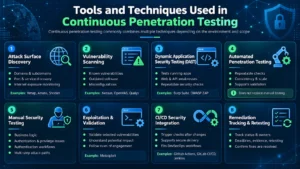
Tools and Techniques Used in Continuous Penetration Testing
The exact toolset depends on the environment and testing scope.Continuous penetration testing commonly combines multiple techniques.
Attack Surface Discovery
Attack surface discovery helps identify systems and services exposed to potential attackers.
Tools may support:
- Domain discovery
- Subdomain enumeration
- Port discovery
- Service identification
- Internet exposure monitoring
Examples of tools commonly associated with discovery include Nmap, Amass, and Shodan.
Vulnerability Scanning
Vulnerability scanners identify known vulnerabilities, outdated software, and common configuration problems.
Examples include:
- Nessus
- OpenVAS
- Qualys
Scanning can provide broad coverage, but findings should be validated before they are treated as confirmed exploitable vulnerabilities.
Dynamic Application Security Testing
DAST tests applications while they are running.Tools such as Burp Suite and OWASP ZAP can help identify application security weaknesses across web applications and APIs.DAST can be useful for repeatable security testing during development and deployment workflows.
Automated Penetration Testing
Automated penetration testing platforms can repeat defined security checks and assist with vulnerability validation.Their main advantage is consistency and scalability.However, automated pen testing should not be treated as a complete replacement for manual testing where business logic, unusual workflows, or complex attack paths are involved.
Manual Security Testing
Human testing remains important for areas such as:
- Business logic
- Authorization
- Privilege escalation
- Authentication workflows
- Chained vulnerabilities
- Multi-step attacks
- Application-specific behavior
The value of manual testing comes from understanding context rather than simply checking for known vulnerability signatures.
Exploitation and Validation
Security testing frameworks such as Metasploit may be used within properly authorized engagements to validate selected vulnerabilities and understand potential impact.Exploit validation should always follow agreed rules of engagement and testing safeguards.
CI/CD Security Integration
Security testing can also be connected to development pipelines.
Examples of CI/CD platforms include:
- GitHub Actions
- GitLab CI/CD
- Jenkins
Security checks can be triggered after important code or infrastructure changes.This helps align application security validation with software delivery.
Remediation Tracking and Retesting
Findings need to move from security teams to the people responsible for remediation.
Ticketing and workflow platforms can help track:
- Vulnerability status
- Assigned owners
- Remediation deadlines
- Evidence
- Retesting
- Closure
After a fix is implemented, the affected component should be tested again to confirm that the risk has been addressed.
How Continuous Penetration Testing Fits Into DevSecOps
Continuous penetration testing can support a broader DevSecOps strategy by bringing security validation closer to the development process.Different security controls can operate at different stages.
During development, teams may use:
- Static application security testing
- Dependency scanning
- Secret scanning
- Secure code review
During build and deployment, teams may use:
- Infrastructure-as-code scanning
- Container security checks
- DAST
- API security testing
After deployment, continuous penetration testing can help validate the security of the running environment.This layered approach allows organizations to detect some weaknesses early while still testing how the deployed system behaves in practice.
How to Build an Effective Continuous Pen Testing Program
A successful continuous penetration testing program requires more than purchasing an automated tool.Organizations should establish a clear operating model.
Define the Scope
Identify which applications, APIs, infrastructure, networks, and cloud environments require ongoing testing.
Identify High-Risk Changes
Determine which events should trigger additional testing. Examples include authentication changes, public API releases, major deployments, and infrastructure modifications.
Combine Automation With Human Validation
Use automation where repeatability and scale are valuable, while reserving expert analysis for weaknesses that require context.
Establish Remediation Ownership
Every confirmed finding should have a clear owner and remediation process.
Define Retesting Requirements
Determine which vulnerabilities require validation after remediation and how quickly retesting should occur.
Track Useful Security Metrics
Useful measures may include:
- Time to validate findings
- Time to remediate
- Time to retest
- Recurring vulnerability types
- Number of high-risk findings
- Assets added to the attack surface
- Percentage of confirmed findings remediated
The objective should be reducing real security exposure, not simply increasing the number of tests performed.
How CyberZEALS Conducts Continuous Penetration Testing
CyberZEALS supports continuous penetration testing through a combination of penetration testing service, application security testing, API security testing, cloud security testing, automated security checks, and remediation validation.The exact testing approach depends on the agreed scope, system architecture, attack surface, deployment frequency, and security requirements.Testing can cover web applications, APIs, cloud assets, networks, infrastructure, and other exposed systems as they change over time.Automated testing can provide recurring coverage and identify potential weaknesses efficiently. Findings that require further analysis can then be reviewed in context to determine whether they create practical security risk.
Confirmed vulnerabilities are prioritized according to factors such as exploitability, exposure, affected assets, and potential impact.Security and development teams receive actionable findings that explain what was identified, why it matters, and what should be addressed.After remediation, affected areas can be retested to confirm that the weakness has been resolved.This approach helps organizations keep security validation more closely aligned with changes in their applications and infrastructure instead of relying only on occasional point-in-time assessments.
Frequently Asked Questions About Continuous Penetration Testing
Does continuous penetration testing run all the time?
Not necessarily. Testing may run on a recurring schedule or be triggered by important application, API, cloud, or infrastructure changes.
Is continuous penetration testing the same as vulnerability scanning?
No. Vulnerability scanning primarily identifies potential weaknesses, while penetration testing goes further by validating exploitability and practical security impact.
Can system changes trigger a continuous penetration test?
Yes. Deployments, API updates, authentication changes, infrastructure modifications, and new integrations can be used as testing triggers.
Can continuous penetration testing replace traditional penetration testing?
Not always. Continuous testing provides more frequent coverage, while focused traditional penetration tests can still provide deeper assessment for major releases or defined high-risk environments.
Is automated penetration testing enough on its own?
No. Automation provides repeatable coverage, but complex authorization, business logic, attack chains, and application-specific behavior may require human testing.
Is continuous penetration testing the same as PTaaS?
No. Continuous penetration testing describes a testing approach or cadence, while PTaaS describes a model for delivering penetration testing services.
Does continuous penetration testing work for APIs?
Yes. APIs are well suited to ongoing security validation because endpoints, authentication mechanisms, access controls, and integrations can change frequently.
Is continuous penetration testing useful for cloud environments?
Yes. Dynamic cloud environments can change rapidly through new workloads, permissions, services, and configuration updates, making recurring security validation useful.
Can continuous penetration testing integrate with CI/CD pipelines?
Yes. Selected security checks can be triggered by development and deployment events, while deeper validation can be performed according to risk and scope.
What happens after a vulnerability is fixed?
The affected system can be retested to confirm that the vulnerability has been properly remediated and that the original attack path is no longer available.
If you have any query, then contact us now and get in touch with us.