
1. Customer
- Industry: Professional Services (Small-Mid-sized Business)
- Location: USA
- Employees: 75
- Environment: Hybrid (on-prem servers, cloud apps, remote workforce)
- Services: Cybersecurity Assessment, Managed Detection & Response (MDR), Security Awareness Training, Policy & Governance
- Key Outcomes:
- 60% reduction in security incidents impacting operations
- Mean time to detect (MTTD) improved from days to under 30 minutes
- 90%+ employee completion rate for security awareness training
- Passed external security audit with no major findings
2. Client Background
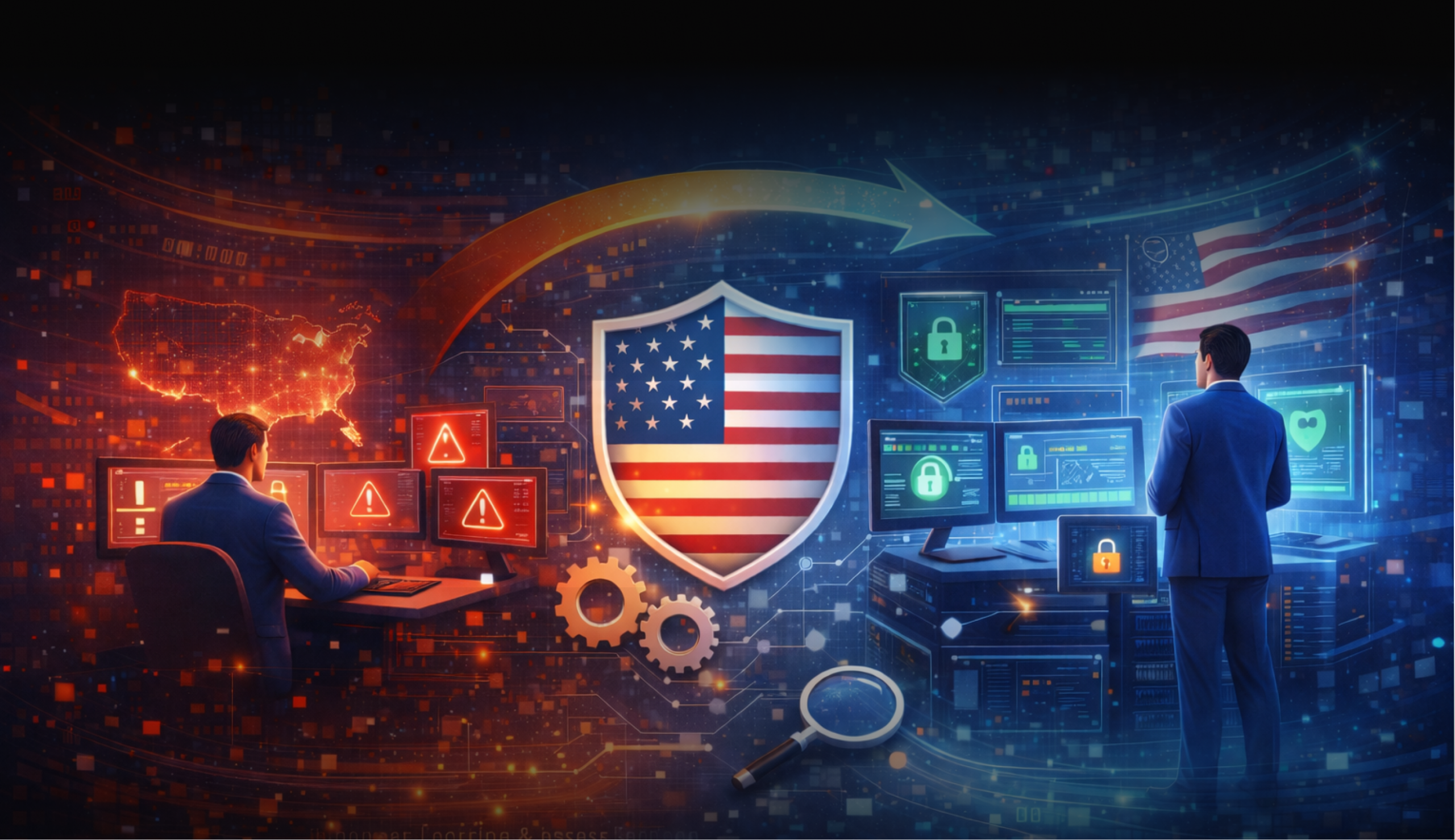
The client is a growing professional services firm that handles sensitive customer data and relies on digital tools for day-to-day operations. As they expanded, their attack surface grew: more cloud apps, more remote workers, and more data flowing between systems. Security had been handled informally by the internal IT generalist, with no dedicated security function or formal program.
3. Challenges (Before Proactive Cyber Defense)
Before engaging the cybersecurity team, the organization operated in a reactive mode, responding to issues only after they became obvious problems. Key challenges included:
- Sporadic antivirus alerts and phishing attempts handled on a best-effort basis.
- No centralized visibility into endpoints, user behavior, or network traffic.
- Inconsistent patching and outdated systems, creating exploitable vulnerabilities.
- Lack of documented security policies, incident response plans, or user training.
- Growing concern from leadership after near-miss incidents and increasing cyber insurance requirements.
This reactive approach left the business exposed to data breaches, ransomware, and reputational damage, while also making it difficult to demonstrate security maturity to clients and insurers.
4. Objectives and Requirements
Together, the client and cybersecurity provider defined clear objectives for building a proactive cyber defense program:
- Move from ad-hoc, reactive security to a structured, continuous defense approach.
- Gain real-time visibility into threats across endpoints, identities, email, and cloud services.
- Reduce the likelihood and impact of successful phishing, malware, or ransomware attacks.
- Establish security policies, standards, and an incident response playbook.
- Strengthen the client’s security posture to meet customer, partner, and insurance expectations.
5. Consulting Approach
The engagement followed a phased, consultative approach:
- Performed a comprehensive security assessment covering infrastructure, endpoints, identity management, email, and cloud services.
- Reviewed logs, past incidents, and existing security tools to identify gaps and overlaps.
- Conducted stakeholder workshops with IT, leadership, and key business owners to understand risk tolerance and critical assets.
- Prioritized risks and mapped them to a practical roadmap aligned with industry best practices (e.g., CIS Controls, NIST-style principles).
- Designed a right-sized security operating model for an SMB, including roles, responsibilities, and escalation paths.
This approach ensured the security program was both effective and realistic for the client’s size, budget, and internal capabilities.
6. Solution Implemented
The solution combined technology, process, and people to create a proactive cyber defense program.
Threat Detection and Monitoring
- Implemented a managed detection and response (MDR) platform to collect and analyze logs from endpoints, servers, and cloud services.
- Configured correlation rules and alerts for suspicious activities such as unusual logins, privilege escalation, lateral movement, and data exfiltration.
- Established 24/7 monitoring with a security operations team to investigate and respond to high-priority alerts.
Endpoint, Email, and Identity Security
- Deployed advanced endpoint protection/EDR across all workstations and servers.
- Hardened email security with anti-phishing, attachment scanning, and URL protection.
- Enforced multi-factor authentication (MFA) for remote access and critical applications.
- Standardized configuration baselines and implemented least-privilege access for users and admins.
Policies, Governance, and Incident Response
- Developed and formalized key security policies (acceptable use, access control, password/MFA, incident response, backup and recovery).
- Created an incident response plan with defined roles, communication flows, and decision points.
- Conducted tabletop exercises to rehearse response to phishing, ransomware, and data loss scenarios.
Security Awareness and Culture
- Launched an ongoing security awareness program with short, targeted training modules.
- Ran simulated phishing campaigns to measure and improve user resilience.
- Provided tailored guidance for high-risk groups such as finance, HR, and executives.
7. Results and Metrics
Within the first 9-12 months, the organization saw measurable improvements in its security posture:
- Security incidents that disrupted business operations dropped by around 60%, as many threats were detected and contained early.
- Mean time to detect (MTTD) potential threats decreased from several days (or never detected) to under 30 minutes for high-severity alerts.
- Mean time to respond (MTTR) improved significantly thanks to predefined playbooks and a dedicated security response team.
- Phishing simulation failure rates declined steadily as employees became more aware and vigilant.
- The company successfully passed an external security assessment required by a major client and met new cyber insurance requirements without major remediation demands.
These outcomes gave leadership greater confidence in their ability to withstand cyber threats and use security as a business enabler rather than a constant worry.
8. Client Quote or Testimonial
“We used to hear about security only when something went wrong. Now, we have clear visibility, regular reports, and a partner watching our environment 24/7. Incidents are fewer, and when they do happen, they’re handled quickly and professionally. Our clients and insurers can see that we take cybersecurity seriously.”
9. Visuals and Technical Artifacts (Optional)
For your website case study, you can enhance this story with:
- A simple diagram of the new cyber defense architecture (users → endpoints → MDR/EDR → SOC).
- A before/after timeline showing improvements in detection and response times.
- An anonymized sample of a monthly security report summarizing alerts, incidents, and training progress.
10. Call to Action
If your business is still handling security on a reactive, “as-needed” basis, you may be exposed to threats you cannot see. Get in touch to schedule a cybersecurity assessment and learn how a proactive cyber defense program can reduce your risk, improve visibility, and satisfy client and insurance requirements.