
At a Glance
Client | [Client name or “A professional services firm”] |
Industry | Professional Services |
Size | ~[50] employees, [2] offices |
| Services | Managed IT, Help-Desk, Cybersecurity, vCIO |
| Engagement | [12]+ months, ongoing |
| Region | [US / Pakistan / UAE] |
The Challenge
The firm had grown from a small team to [50] people, but its IT had not kept pace. A single in-house IT administrator carried every responsibility: user support, servers, backups, security and vendor management.
The problems were clear:
No response commitment. When systems went down, staff waited for whenever the administrator was free. There was no definition of “urgent” and no target time to respond.
Single point of failure. Leave, illness or resignation would have left the firm with no IT coverage at all.
Security gaps. Patching was inconsistent, multi-factor authentication was not enforced, and backups were never tested by restoring.
No after-hours coverage. Incidents outside business hours were handled informally, if at all.
No strategic direction. Leadership had no IT roadmap, no budget forecast and no visibility into risk. IT was seen as a cost, not a business enabler.
The firm’s clients had also begun asking security questionnaires, and leadership knew the current setup would not stand up to scrutiny.
Our Approach
CyberZEALS ran a structured onboarding followed by an ongoing managed service built around defined, measurable commitments.
Phase 1: Discovery and Stabilization (Weeks 1-4)
Full asset and user inventory across devices, servers, cloud services and licenses
Security baseline assessment covering patching, endpoints, email, identity and backups
Documentation of network, credentials and processes in a central, access-controlled system
Quick wins: MFA enforcement, backup verification, removal of stale accounts, critical patching
Phase 2: Service Design and SLA Definition (Weeks 3-6)
We agreed severity definitions and response commitments with the client in writing.
| Priority | Definition | Response Target |
|---|---|---|
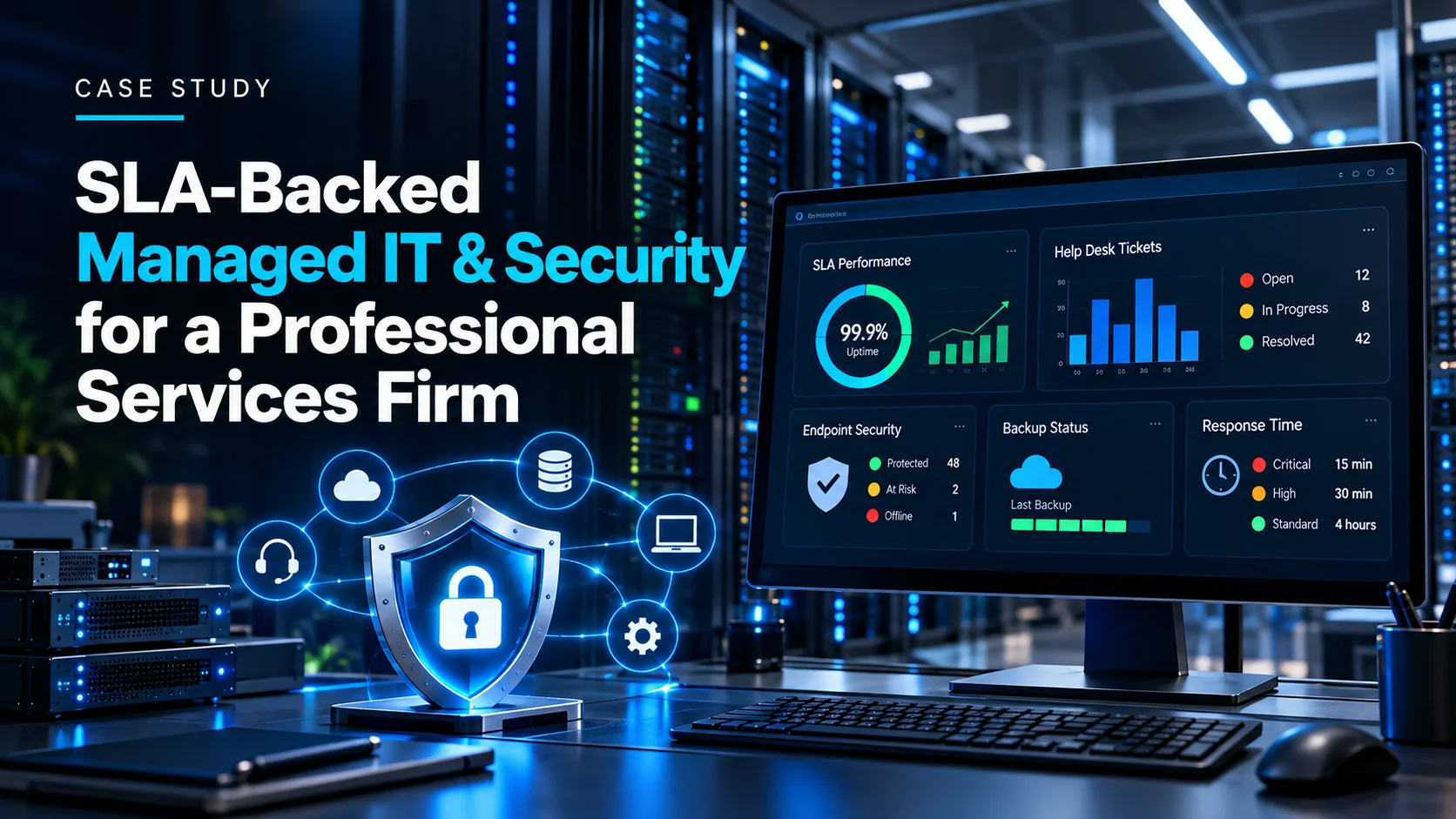
Critical | Business-stopping outage or active security incident | 15 minutes |
High | Major degradation affecting a team or key system | 30 minutes |
| Standard | Single-user issues and routine requests | 4 hours |
Response time is the time from ticket creation or alert to a qualified engineer actively engaged.
Phase 3: Ongoing Managed Service
Help-Desk Staff raise issues by phone, email or portal. Every request becomes a tracked ticket, is categorized by priority, and is handled by a defined support tier.
Escalation Process
Tier 1: Help-desk triage and first-line resolution
Tier 2: Senior engineer for complex or unresolved issues
Tier 3: Security lead or architect for incidents, major outages and root-cause analysis
Management escalation: Service manager contacts the client’s designated executive if a Critical ticket exceeds [X] hours
After-Hours Process Critical and High alerts trigger an on-call rotation outside business hours. The on-call engineer acknowledges within the SLA, and the client receives a status update at defined intervals until resolution. Standard requests wait for the next business day.
Proactive Monitoring and Security
24/7 monitoring of servers, network and cloud services
Automated patch management with monthly maintenance windows
Endpoint protection, email security and MFA across all users
Backup monitoring with scheduled restore tests
Customer Reporting Every month the client receives a report covering ticket volumes and categories, response and resolution times against SLA, uptime, patch compliance, security events and recommendations.
Quarterly Business Reviews (QBRs) Each quarter we meet with leadership to review performance against targets, assess risk, discuss upcoming changes, and align technology with business goals.
vCIO Cadence A virtual CIO provides strategic guidance through:
An annual IT roadmap and budget
Quarterly roadmap reviews at each QBR
Risk register and security posture tracking
Vendor and license reviews
Planning for growth, new offices and compliance requirements
Results
After [12] months of managed service:
| Metric | Before | After |
|---|---|---|
Uptime of core systems | Not measured | [99.X]% (target: [99.9]%) |
Average Critical response time | Undefined | [X] minutes (SLA: 15) |
Average High response time | Undefined | [X] minutes (SLA: 30) |
Standard tickets within SLA | Undefined | [X]% (SLA: 4 hours) |
| MFA coverage | [X]% | 100% |
| Patch compliance | [X]% | [X]% |
| Recurring tickets | Baseline | [X]% reduction |
| Backup restore tested | Never | Quarterly |
Business impact:
No single point of failure, since the firm now has a full team behind it rather than one person
Fewer disruptions, with proactive monitoring catching issues before staff noticed
Leadership gained a clear IT roadmap and predictable annual budget
The firm completed client security questionnaires with confidence
The internal IT administrator was freed to focus on [projects / business systems] instead of firefighting
Key Takeaways
Defined commitments build trust. Written response targets turn “we’ll get to it” into an accountable promise.
Proactive beats reactive. Monitoring, patching and tested backups prevent most incidents before they affect staff.
Strategy matters as much as support. Quarterly reviews and vCIO guidance move IT from a cost center to a business enabler.
About CyberZEALS
CyberZEALS delivers cybersecurity, managed IT and compliance services, including penetration testing, security audits, and SLA-backed managed support, for organizations that need dependable protection and clear accountability.
Website: cyberzeals.com
Want to see how an SLA-backed managed service could work for your organization? Book a free assessment.