
Penetration testing helps organizations understand their security weaknesses, and the types of penetration testing in cybersecurity determine how different systems and attack scenarios are assessed. By testing systems from an attacker’s point of view, security teams can see where defenses may fail and which weaknesses could create real risks if exploited.
There are different types of penetration testing because networks, applications, APIs, cloud environments, wireless systems, and users face different threats. Testing can also vary based on how much information the tester receives and the method used during the assessment. Understanding these approaches helps organizations choose testing that matches their systems, risks, and security goals.

What Is Penetration Testing and Why Is It Performed?
Penetration testing is an authorized security assessment in which testers use controlled attack techniques to find and validate weaknesses in an organization’s systems. Unlike a basic vulnerability scan, it goes further by checking whether selected weaknesses can actually be exploited and what access an attacker might gain. Organizations perform penetration testing to understand their real security exposure. It helps verify whether existing controls are working, uncover possible attack paths, and show which vulnerabilities should be fixed first.
Penetration testing also plays an important role in cybersecurity by giving security teams practical evidence instead of relying only on automated findings or assumptions. It can support risk management, remediation planning, and security improvement by showing how weaknesses could affect real systems and business operations.
Types of Penetration Testing by Target
One way to classify the different types of penetration testing is by the technology or attack surface being assessed. Each target presents different risks and requires a different testing focus.
Network Penetration Testing
Network penetration testing evaluates internal or external network infrastructure for vulnerabilities, exposed services, weak configurations, access control problems, and other conditions that could enable unauthorized access. External testing focuses on internet-facing systems such as servers, VPN gateways, firewalls, and remote access services.
Internal testing examines what an attacker or compromised user could reach after gaining access inside the environment. The goal is not simply to identify open ports. It is to understand whether network weaknesses can be exploited and whether an initial compromise could lead to lateral movement or access to more sensitive systems.
Web Application Penetration Testing
Web application penetration testing focuses on security weaknesses in websites, portals, SaaS applications, and other browser-based systems. Testing may examine authentication, session management, access controls, input handling, business logic, data exposure, and common application vulnerabilities.
It can also determine whether users can access functions or information beyond the permissions intended for their accounts. This type of testing is particularly useful for applications that process sensitive information or provide important customer and business functions.
API Penetration Testing
API penetration testing assesses the interfaces applications use to exchange data and perform actions. APIs can expose sensitive information or business functions even when the user-facing application appears secure. Testing therefore examines authentication, authorization, data validation, rate controls, endpoint exposure, and whether users can manipulate requests to perform unauthorized actions. API testing has become increasingly important as applications rely on integrations between internal systems, mobile apps, cloud platforms, and third-party services.
Mobile Application Penetration Testing
Mobile Application penetration testing evaluates security across the application itself and the services it communicates with. Testing may review local data storage, authentication, session handling, insecure communication, application permissions, API interactions, and platform-specific security controls.
Because mobile applications often connect directly to backend APIs and sensitive user data, effective testing looks beyond the device and considers the wider application environment.
Wireless Penetration Testing
Wireless penetration testing assesses Wi-Fi networks and related infrastructure for weaknesses that could allow unauthorized access or provide a path into internal systems. Testing may cover authentication controls, encryption configurations, network segmentation, rogue access point risks, and the separation between guest and corporate wireless networks.
For organizations that depend heavily on wireless connectivity, this type of testing helps determine whether proximity to the network could create an additional attack path.
Cloud Penetration Testing
Cloud penetration testing examines cloud-hosted workloads, services, identities, configurations, and access relationships for exploitable weaknesses. The specific approach depends on the cloud provider, architecture, and testing permissions. Assessments may consider identity and access management, storage exposure, network configuration, workloads, application services, and privilege escalation opportunities. Cloud penetration testing should be carefully scoped because cloud environments often involve shared infrastructure and provider-specific testing rules.
Social Engineering Penetration Testing
Social engineering penetration testing focuses on people and processes rather than only technical systems. A controlled assessment may evaluate whether employees respond securely to phishing attempts, fraudulent requests, impersonation, or other manipulation techniques. The purpose is to understand whether an attacker could bypass technical security by persuading a person to reveal information, approve access, or take an unsafe action.
Penetration Testing Approaches: Black, White, and Gray Box
Penetration testing can also be classified by how much information and access the tester receives before the assessment begins. The three common approaches are black box, white box, and gray box penetration testing. Each creates a different testing perspective and is useful for answering different security questions.
Black Box Penetration Testing
In black box penetration testing, the tester begins with little or no internal knowledge of the target environment. This approach closely reflects the perspective of an external attacker who must first discover systems, services, and possible entry points.
It is useful for assessing what an attacker could identify and exploit without privileged information. However, more testing time may be spent on reconnaissance, which can limit how deeply some areas are assessed.
White Box Penetration Testing
White box penetration testing gives the tester extensive knowledge of the environment. This may include architecture details, source code, credentials, configurations, network diagrams, and other internal documentation.
Because the tester has greater visibility, more of the attack surface can be examined in depth. This approach is useful when comprehensive coverage is more important than simulating an attacker with no prior knowledge.
Gray Box Penetration Testing
Gray box penetration testing sits between black box and white box testing. The tester receives limited information or access, such as a standard user account, selected architecture details, or credentials for a specific role.
This approach can simulate a situation in which an attacker has already gained limited access. It is particularly useful for understanding what a compromised account or partially trusted user could do inside the environment.
Black Box vs White Box vs Gray Box Penetration Testing: Key Differences
No single approach is always better. The right choice depends on the testing objective, available information, and the attacker scenario the organization wants to evaluate.
Factor | Black Box | White Box | Gray Box |
Tester knowledge | Minimal | Extensive | Limited |
Main perspective | External attacker | Informed tester | Partially informed attacker |
| Reconnaissance required | High | Low | Moderate |
| Testing depth | Can be narrower | Usually deeper | Balanced |
| Common use | External exposure | Detailed security review | Compromised user scenarios |
Types of Penetration Testing Methodology
Different penetration testing methodologies provide a structured way to plan and conduct an assessment. Unlike the types of penetration testing, which are based on the target being tested, or box approaches, which describe how much information the tester receives, a methodology defines the process followed during testing
OWASP Testing Methodology
The Open Worldwide Application Security Project, commonly known as OWASP, provides extensive guidance for testing web applications and related technologies. OWASP resources are widely used to examine application security areas such as authentication, authorization, session management, input validation, configuration, and business logic.
PTES
The Penetration Testing Execution Standard, or PTES, organizes penetration testing into structured stages. These include pre-engagement activities, intelligence gathering, threat modeling, vulnerability analysis, exploitation, post-exploitation, and reporting. PTES is useful because it considers the complete engagement rather than focusing only on the exploitation phase.
NIST-Based Penetration Testing
The National Institute of Standards and Technology provides guidance that organizations can use when planning and performing security assessments. A NIST-aligned approach can help organizations integrate penetration testing with broader risk management, control assessment, and security testing activities.
OSSTMM
The Open Source Security Testing Methodology Manual, or OSSTMM, provides a structured framework for security testing across operational environments. It can be used to support consistent testing processes and documentation across areas that extend beyond a single application or technology. In practice, experienced penetration testers may draw from more than one methodology depending on the environment and engagement objectives.
How Penetration Testing Supports Cybersecurity
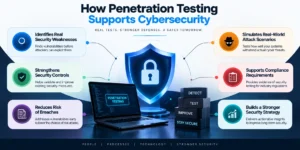
Penetration testing supports cybersecurity by showing how well an organization’s security controls perform against real attack techniques. It connects directly with cybersecurity because it tests whether weaknesses in networks, applications, access controls, and other systems could be used to gain unauthorized access or reach sensitive assets. Different types of penetration testing support cybersecurity in different areas. For example, network testing evaluates infrastructure security, web application testing checks application weaknesses, and cloud testing reviews risks in cloud environments.
Together, these assessments help security teams understand where defenses are strong and where gaps still exist. Penetration testing also helps organizations prioritize remediation. Instead of treating every vulnerability as equally important, teams can focus first on weaknesses that create realistic attack paths or expose critical systems. This makes penetration testing an important part of a broader cybersecurity program focused on reducing risk and improving security controls.
How CyberZEALS Approaches Penetration Testing
When businesses want to know where their security could improve, CyberZEALS takes a practical approach. Our Penetration Testing Services in USA help with identifying and validating vulnerabilities, while our broader Cybersecurity Services in USA give extra support for strengthening your overall security environment. We develop the testing scope, evaluate the relevant systems, validate findings, and make actionable recommendations for your team.
Whether you need to examine your external attack surface, identify vulnerabilities, or better understand your present security risks, We will assist you in selecting a testing approach that is appropriate for your environment and security objectives.
Frequently Asked Questions
What are the main types of penetration testing?
The main types include network, web application, API, mobile, wireless, cloud, and social engineering testing.
How do you choose the right type of penetration testing?
Choose based on the system being tested, the risk involved, and the attacker scenario you want to simulate.
Can businesses use more than one penetration testing approach?
Yes. Organizations often combine different testing types and box approaches for broader coverage.
How is penetration testing different from vulnerability scanning?
Vulnerability scanning finds potential weaknesses, while penetration testing validates whether selected weaknesses can be exploited.
Does compliance affect penetration testing requirements?
Yes. Some frameworks may define testing scope, frequency, or evidence requirements.
Should penetration testing be repeated after fixes?
Yes. Retesting helps confirm that important vulnerabilities were properly remediated.